





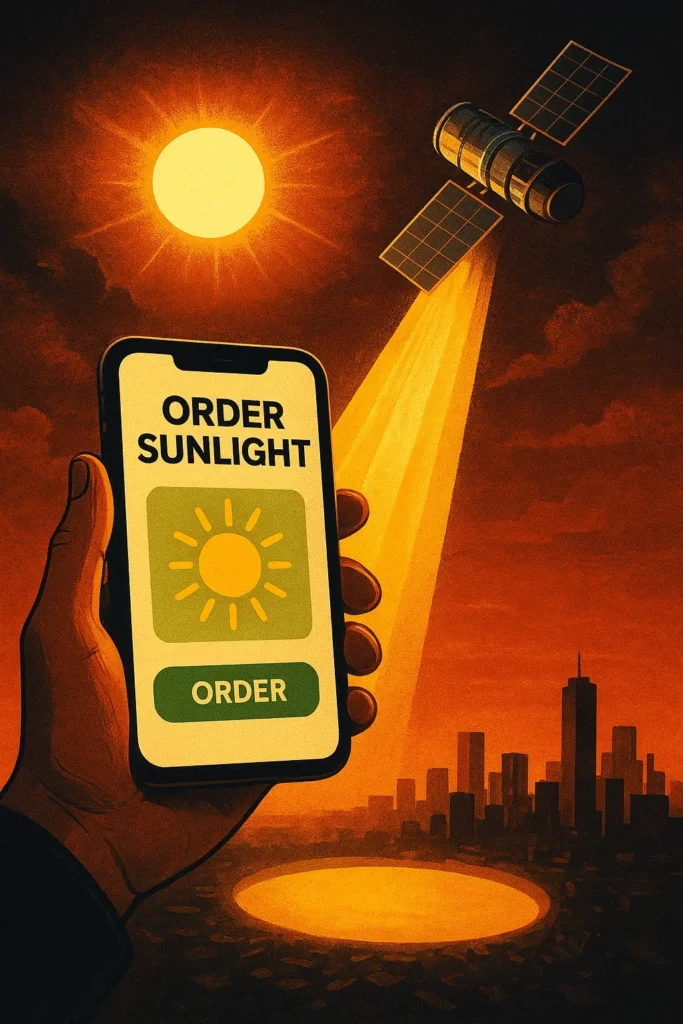
What if you could order sunlight the same way you order food from an app? Sounds impossible, right? Well, a company called Reflect Orbital is making that wild idea a reality.
Uber Eats for the Sun
Reflect Orbital was founded by two entrepreneurs with a futuristic vision: launch reflective satellites into orbit, position them at the right angles, and beam sunlight down to Earth on demand.
The concept is simple yet revolutionary; the sun never turns off, it’s essentially a giant nuclear reactor. By bouncing light from orbiting space mirrors, Reflect Orbital can direct sunlight to places experiencing darkness.
It’s like Uber Eats, but instead of ordering pizza, you’re ordering beams of sunlight.
Why Build This?
The company’s original purpose was to solve a major renewable energy challenge, powering solar farms at night.
If sunlight can be redirected to the “dark side” of Earth, solar panels can continue generating energy long after sunset. This innovation could completely reshape the way we think about renewable power and sustainability.

Sunlight on Demand
Reflect Orbital’s idea of “selling sunlight at night” sounded like science fiction in 2024. In 2026, it is becoming a real space-tech project attracting millions in funding, FCC attention, and growing concern from astronomers and environmental researchers worldwide.
Anyone will be able to purchase sunlight in the form of a 3-mile-wide circle of light coverage, available in 4-minute chunks, anywhere on the planet.
Imagine tapping a button on your phone and suddenly lighting up all of Lower Manhattan with artificial daylight.
Real-World Impact: Disaster Relief & Survival
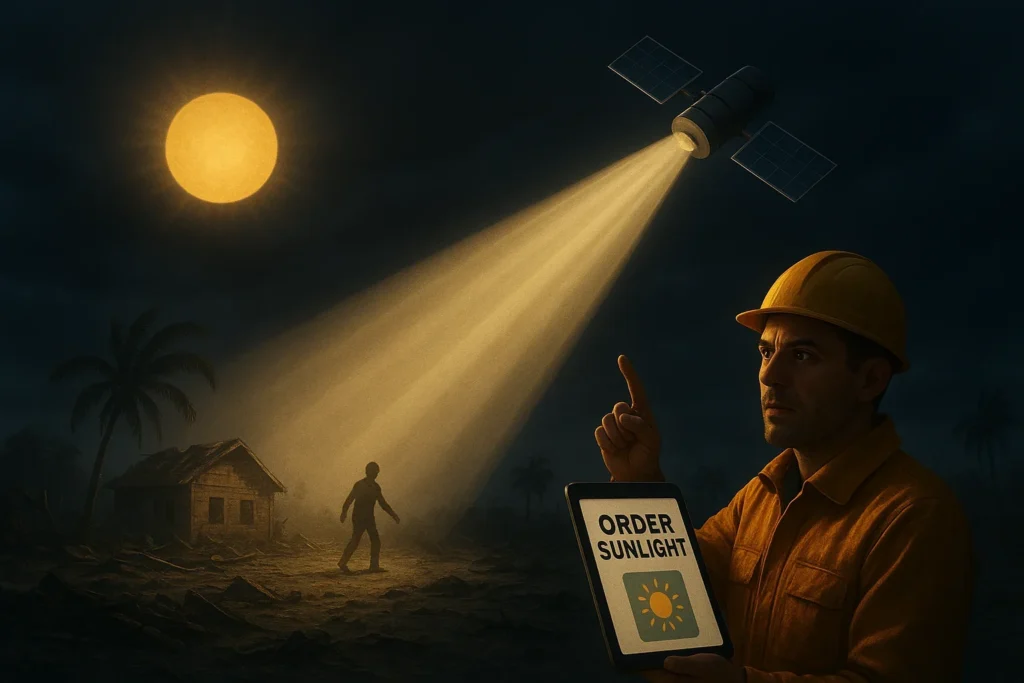
As futuristic as it sounds, the applications are practical too. During recent natural disasters in North Carolina, Georgia, and Florida caused by Hurricanes Helene and Milton, vast regions lost power for days.
Reflect Orbital’s technology could:
- Light up disaster zones for emergency crews.
- Spotlight stranded people at night for easier rescues.
- Power solar generators even during outages.
In short, it’s not just about convenience; it could save lives.

Reflect Orbital’s 2026 Expansion Plans
Reflect Orbital has significantly expanded since its early viral exposure online.
By 2026, the company has:
- Raised approximately $20 million in Series A funding
- Increased engineering recruitment
- Expanded prototype development
- Continued regulatory discussions
- Prepared for early orbital demonstrations
The company is also reportedly exploring partnerships connected to:
- Space launch providers
- renewable energy operators
- aerospace contractors
Its long-term roadmap suggests larger satellite deployments could begin later this decade if testing proves successful.
Why Reflect Orbital Wants to Sell Sunlight
The company argues that nighttime sunlight reflection could solve several operational challenges.
One major target is the renewable energy industry. Solar farms stop generating electricity after sunset, even when energy demand remains high. Reflect Orbital believes orbital mirrors could extend solar generation windows without requiring entirely new power infrastructure.
The company also points toward emergency applications.
Possible future use cases include:
- Disaster relief after storms
- Emergency nighttime visibility
- Search and rescue support
- Temporary industrial lighting
- Arctic operations with limited daylight
The concept has become particularly interesting for remote regions where infrastructure development is difficult.
Scientists Are Raising Serious Concerns
While the concept sounds innovative, many scientists remain deeply concerned about the environmental consequences.
Astronomers argue that orbital mirrors could worsen an already growing problem: artificial light pollution from space. Over the last few years, satellite constellations from companies like SpaceX have already created visibility issues for observatories worldwide.
Adding reflective orbital mirrors could increase those concerns significantly.
Researchers warn about possible impacts on:
- Ground-based astronomy
- Wildlife migration
- Nocturnal animal behavior
- Human circadian rhythms
- Dark-sky preservation efforts
Environmental organizations such as DarkSky International have raised concerns that orbital illumination systems could permanently alter the natural night sky if large-scale deployments become common.
Some astronomers also worry that reflective satellites could interfere with deep-space observations and long-exposure imaging.
Can Reflect Orbital Actually Light Up Cities?
Not exactly.
Current plans do not involve creating full artificial daylight across major urban regions. Instead, the company appears focused on localized illumination with relatively low brightness intensity.
The reflected light would likely resemble:
- Bright moonlight
- Dawn-like illumination
- Low-level atmospheric glow
This limitation is important because many early social media discussions exaggerated the project’s capabilities.
At least in the near future, Reflect Orbital is not expected to create daytime conditions at night.
Could Governments Regulate Space Mirrors?
Regulation is becoming a major discussion point in 2026.
Because orbital reflection systems affect visibility, aviation, astronomy, and environmental conditions, regulatory agencies may eventually require new frameworks specifically for space-based illumination technologies.
Potential regulatory concerns include:
- Light pollution standards
- Satellite brightness restrictions
- International space treaties
- Airspace visibility impacts
- Environmental reviews
As orbital infrastructure becomes more common, governments may need entirely new policies for commercial space-lighting systems.
Final Thoughts
Reflect Orbital’s sunlight satellites are no longer just an internet curiosity. In 2026, the project represents a real attempt to commercialize orbital light reflection technology.
The company’s plans continue attracting attention because the idea sits at the intersection of:
- renewable energy
- aerospace engineering
- environmental science
- astronomy
- commercial space innovation
At the same time, criticism surrounding light pollution and ecological impact is growing just as quickly as public interest.
Whether Reflect Orbital becomes a revolutionary energy-support system or a controversial experiment in artificial illumination, one thing is clear: the debate around controlling sunlight from space has only just begun.