

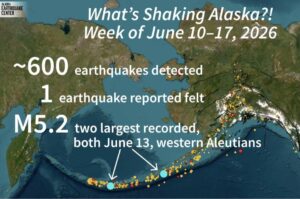

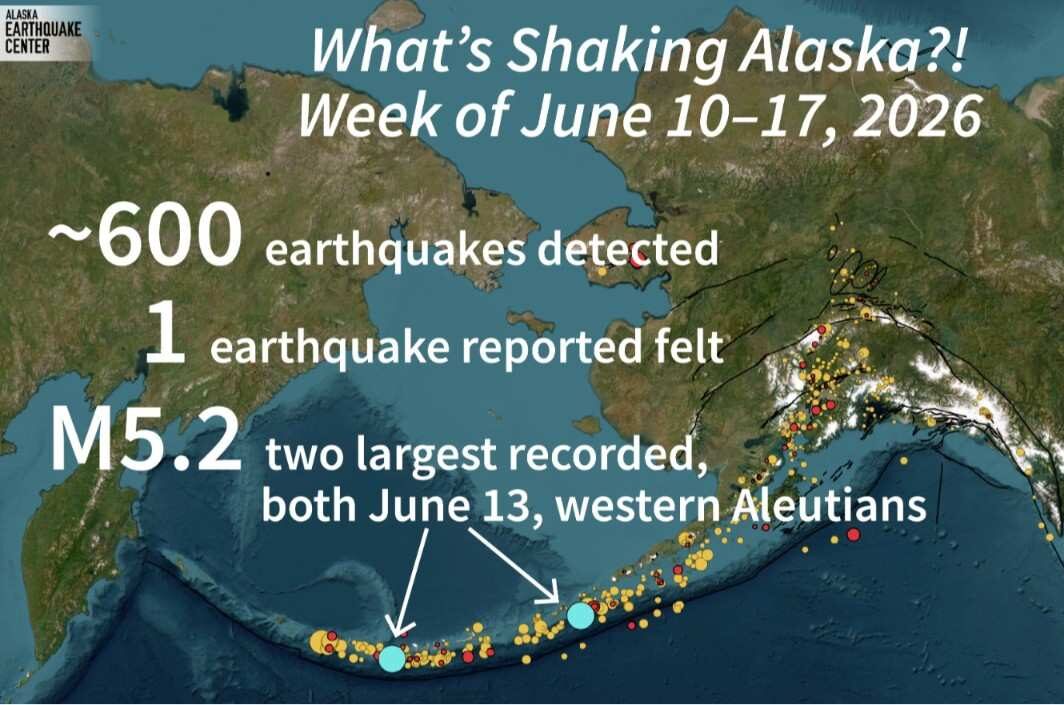
The Alaska Earthquake Center recorded about 600 earthquakes across the state during the week of June 17, according to its latest seismic update. Two magnitude 5.2 earthquakes that struck the western Aleutians on June 13 were the largest events of the week, and one earthquake was reported as felt.
Along with the weekly earthquake activity, the center offered a look inside one of its lesser-known facilities that tests and calibrates seismic instruments before they are deployed across Alaska.
Located on the University of Alaska Fairbanks campus, the facility is known as CIGO, short for the Jack Townshend College International Geophysical Observatory. The small wooden structure houses shelves filled with equipment awaiting testing or preparation for field installation.
The most important work takes place in the basement, where scientists maintain a temperature-controlled seismic testing vault that stays around 40 degrees year-round. At the center of the room is a concrete slab anchored 10 feet into the ground, providing a stable base for instrument testing.
Several olive-green seismometers, each about the size of a soccer ball, are placed on the slab for approximately a month. During that time, researchers collect seismic data and compare it with readings from a benchmark station located outside the building.
The process allows scientists to identify any instruments that need repairs or adjustments before they are installed at remote monitoring sites across Alaska. By ensuring each sensor is properly calibrated, the Earthquake Center helps maintain the accuracy of the state’s extensive seismic monitoring network.
Residents interested in learning more about Alaska’s earthquake monitoring system can explore the Network section on the Alaska Earthquake Center’s website.