




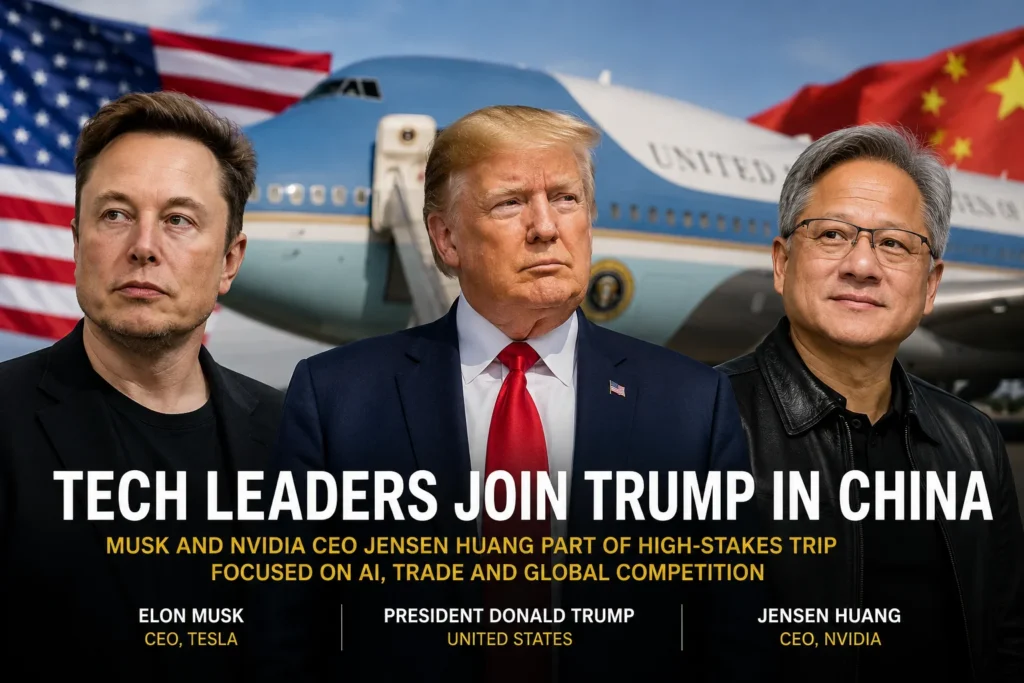
President Donald Trump’s trip to China drew major attention this week after reports revealed that Tesla CEO Elon Musk and Nvidia CEO Jensen Huang joined him aboard Air Force One during the high-profile diplomatic mission.
Huang boarded the presidential aircraft during a stop in Anchorage, Alaska, before the delegation continued on to Beijing for Trump’s summit with Chinese President Xi Jinping.
Alaska Stop Became Unexpected Tech Power Gathering
The Anchorage stop quickly became one of the most talked-about moments of the trip after reports confirmed Huang’s late addition to the delegation.
Business Insider reported that:
- Elon Musk boarded earlier at Joint Base Andrews
- Jensen Huang joined during the Alaska refueling stop
- Trump’s delegation included several major U.S. business leaders
Trump later confirmed Huang’s participation after earlier reports suggested the Nvidia CEO had been excluded from the trip.
AI and Trade Issues Expected to Dominate Talks
The presence of Musk and Huang highlights how artificial intelligence and advanced technology have become central issues in U.S.-China relations.
Nvidia has faced increasing restrictions on exporting advanced AI chips to China due to national security concerns. Huang has publicly argued that limiting access to American AI technology could accelerate China’s efforts to build domestic alternatives.
Meanwhile:
- Tesla continues to compete aggressively in China’s electric vehicle market
- U.S. officials remain focused on trade, semiconductors, and supply chains
- China is seeking relief from some U.S. technology export controls
Trump Arrives in Beijing for High-Stakes Summit
Trump arrived in Beijing on Wednesday for talks with Xi Jinping amid tensions involving:
- Trade disputes
- AI chip restrictions
- Taiwan
- The ongoing Iran conflict
The White House described the visit as a major diplomatic and economic mission aimed at improving U.S.-China business relations.
Reports indicate the administration hopes to expand exports involving:
- Aircraft
- Agriculture
- Energy products
- Advanced technology sectors
Nvidia’s China Access Seen as Key Issue
Huang’s participation has generated particular interest because Nvidia remains deeply tied to China’s AI market.
Analysts estimate China’s AI infrastructure market could eventually exceed tens of billions of dollars, making export restrictions especially important for Nvidia’s long-term growth.
The company recently regained approval to sell some AI chips to China, though restrictions remain on its most advanced processors.
Why This Matters
The trip reflects the growing overlap between:
- Global politics
- Artificial intelligence
- Corporate influence
- National security concerns
The presence of some of America’s most influential tech leaders signals that future U.S.-China relations may increasingly revolve around competition for dominance in AI and advanced technology.
Background: Trump’s First China Visit in Nearly a Decade
Trump’s 2026 trip marks the first visit to China by a U.S. president in nearly nine years.
The summit comes after months of trade tensions and growing geopolitical competition between Washington and Beijing.
Business leaders accompanying the delegation reportedly include executives from:
- Nvidia
- Tesla
- Apple
- BlackRock
- Boeing
Key Insights
- Jensen Huang joined Air Force One during Alaska stop
- Elon Musk also traveled with Trump delegation
- AI chip exports and trade expected to dominate talks
- Trump arrived in Beijing for summit with Xi Jinping
Related Posts
Trump Speaks with China’s Xi as Global Attention Sharpens
Trump Proposes 80% China Tariff Before Trade Talks Begin, Raising Stakes
Trump Exempts Electronics from China Tariffs to Calm Tech Industry Fears
Trump Shifts Stance on Powell and China, Signaling a Softer Tone