



Japanese authorities have warned of a slightly increased risk of a major “megaquake” following a powerful 7.7 magnitude earthquake that struck off the country’s northern coast on Monday.
The offshore quake, centered near the Sanriku region, triggered tsunami alerts and evacuation advisories across multiple coastal areas, though no major damage or widespread casualties were immediately reported.
Quake Triggers Alerts and Evacuations
The earthquake struck at a shallow depth of around 19 kilometers, causing strong shaking across northern Japan and prompting authorities to issue tsunami warnings.
- Waves of up to 80 centimeters were recorded along parts of the coast
- More than 170,000 people were advised to evacuate across several prefectures
- Train services, including bullet trains, were temporarily suspended
Officials later downgraded the tsunami warning after the threat subsided.
Megaquake Risk Slightly Elevated
Japan’s Cabinet Office and the Japan Meteorological Agency said the likelihood of a much larger earthquake, with a magnitude of 8 or higher, has risen temporarily.
- Estimated risk increased to 1%, compared to the usual 0.1% baseline
- The elevated risk is expected to last for about one week following the quake
Authorities emphasized that the advisory is not a prediction, but a precaution based on historical patterns of seismic activity.
Government Urges Preparedness
Prime Minister Sanae Takaichi urged residents in affected regions to review evacuation plans and prepare emergency supplies.
Officials advised people living in coastal communities to:
- Confirm shelter locations
- Prepare emergency kits
- Stay alert for further warnings
The advisory applies to more than 180 coastal towns along northeastern Japan.
Why This Matters
Japan lies along the Pacific “Ring of Fire,” one of the world’s most seismically active zones.
The latest earthquake serves as a reminder of the country’s vulnerability to large-scale disasters, including the devastating 2011 earthquake and tsunami, which killed more than 22,000 people.
Experts note that while the probability of a megaquake remains low, even a small increase in risk is taken seriously due to the potential scale of damage.
Background: A History of Major Quakes
The region near the Japan Trench has experienced several powerful earthquakes over the years, including:
- The 2011 Tōhoku earthquake (magnitude 9.0)
- A 7.5-magnitude quake in late 2025 that also triggered advisories
Monday’s earthquake is part of ongoing seismic activity in the area, where tectonic plates continuously shift beneath the ocean floor.
Key Insights
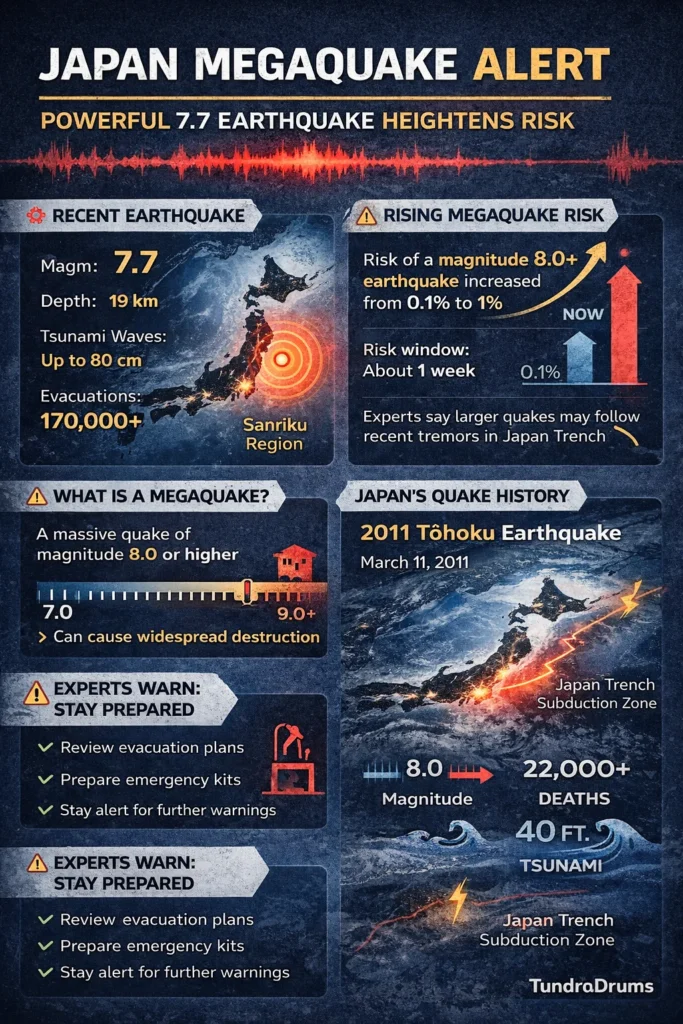
- Magnitude: 7.7
- Depth: ~19 km
- Tsunami waves: Up to 80 cm
- Evacuations: 170,000+ people
- Megaquake risk: Increased to 1% (from 0.1%)
FAQs
What is a megaquake?
A megaquake typically refers to an earthquake with a magnitude of 8.0 or higher, capable of causing widespread destruction.
Is a larger earthquake expected soon?
No specific prediction has been made. Authorities say the risk is slightly higher but still low overall.
Were there casualties?
Only minor injuries have been reported so far, with no major damage confirmed.
Related Posts
Small Earthquake Recorded Near Tatitlek, Alaska Early Tuesday (10 March, 2026)
Minor Earthquake Recorded East of Talkeetna, Alaska Earthquake Center (February 17, 2026)
What’s Shaking Alaska: Weekly Earthquake Summary (February 25, 2026)
Magnitude 2.1 Earthquake Recorded Near Iliamna Volcano (February 24, 2026)
Magnitude 5.4 Earthquake Shakes Kenai Peninsula, Alaska (October 30, 2025)
Vanuatu Earthquake Hits Pacific Island Nation with 7.3 Magnitude (December 17, 2024