





Disclaimer: This article is for informational purposes only and does not constitute medical or legal advice. Readers should consult qualified healthcare professionals or licensed attorneys regarding specific medical conditions, treatment options, or legal matters.
Lung cancer remains the leading cause of death related to cancer in the United States. As more treatment options surface, so does the expansion of the legal space around them. FDA approval timelines and regulatory decisions are no longer just medical concerns. They are influencing how courts handle lung cancer cases. Here is how major drug approval decisions are shaping legal proceedings.
1. Delayed Access Is Becoming a Legal Argument
Many people with lung cancer do not live long enough to use new drugs. This is especially true when a potential treatment passes trials but sits on regulatory uncertainty for months. That gap is now being examined in legal settings. Plaintiff’s legal team is increasingly raising the critical question of whether these delays are foreseeable and preventable. They are looking at why a drug showed strong survival data in trials, but a patient died while waiting for approval.
The argument is still developing in courts. But it draws from established product liability frameworks that hold companies and regulators accountable when systemic failures lead to patient harm. The FDA’s accelerated approval model was designed to move faster for serious conditions. However, patients are left out when companies fail to use it, or when bureaucratic bottlenecks slow it. Lawyers are beginning to argue that this is not just a policy failure. It is a compensable harm.
Also Read: The Three Types of Product Liability Claims You Should Know About
2. Regulatory Decisions Are Being Used as Courtroom Evidence
FDA decisions such as approvals, rejections, label changes, and warning updates are appearing as evidence in lung cancer lawsuits much more frequently. A regulatory ruling can be used in court to tell what a company knew about a drug and what they did about it.
Plaintiff’s complaints routinely focus on product labels and claim they do not adequately reflect risks learned during clinical trials or through post-marketing adverse event reporting. That makes FDA correspondence and review records critical to a victim’s case. A qualified lung cancer lawyer also understands how to use these regulatory records strategically to win cases.
FDA warnings and response letters, and post-market surveillance data paint a picture of corporate ignorance or delayed action. Court proceedings have also revealed practices where companies hid adverse event reports or delayed issuing safety alerts to gain market share. Regulatory timelines help tell that story.
3. Pharmaceutical Companies Face Scrutiny Over Timelines
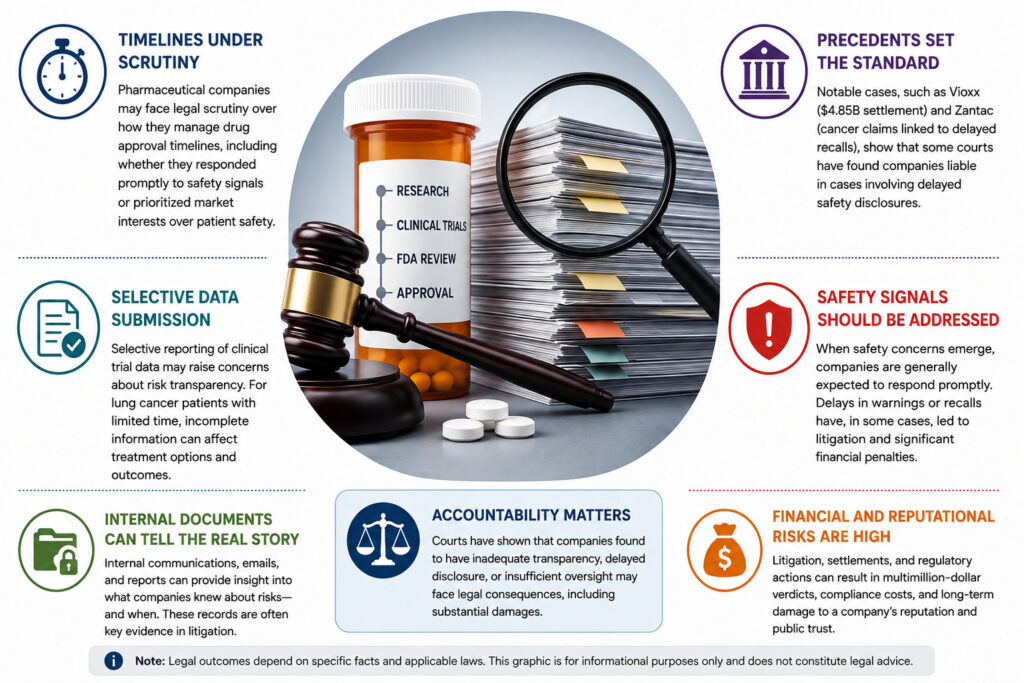
Drug companies are under growing legal pressure over how they manage their approval timelines. That is, specifically, whether they moved fast enough when safety signals emerged, or too slowly to protect their market position.
In some cases, drug companies submit only favorable clinical trial results to the FDA. People get hurt when this happens. For lung cancer patients, where disease progression is rapid, selective data submission can mean the difference between a treatment option and a death sentence.
Courts have seen this before. Merck settled 27,000 Vioxx claims for $4.85 billion after internal documents revealed the company knew about cardiovascular risks long before warning the public. The same type of internal document discovery is now being pursued in lung cancer cases. Firms with spotty timelines now face multimillion-dollar verdicts. Think Zantac suits, where cancer claims are tied to slow recalls. These cases confirm that timelines matter, and hiding safety data carries serious legal consequences.
4. Faster Innovation Is Increasing Legal Pressure
It has been a blinding pace with lung cancer drug development. The era of non-small cell lung cancer (NSCLC) has been fundamentally changed since 2020. Hundreds of FDA approvals are driving this change. Similar priorities have dominated in the regulatory realm, where decisions have largely revolved around precision medicine in 2025. This can be observed via novel antibody-drug conjugates and next-generation targeted therapies.
But the faster new treatments arrive, the more that argument will be harder to keep from pharmaceutical companies. The attorneys who brought the suit state that when a across-the-board higher-quality therapy is available, and a firm sat on data concerning how ill-informed the company was about it, if then their profit could be interpreted as figuring customers at risk so that they may keep selling an inferior product?
Accelerated approval allows drugs onto the market, although there isn’t really that much long-term data. However, the fast-tracked approval for lung cancer drugs is making post-market surveillance critical. The failure of companies to monitor outcomes and react proactively to new indicators of safety becomes a liability. This is where lawsuits start: innovation without accountability.
Endnote
The intersection of FDA regulation and lung cancer lawsuits is getting only more complicated. It is being investigated in court: timelines for approval, selective data submission, and corporate response to evidence of safety signals. Why this legal landscape matters for patients and families with a lung cancer diagnosis related to the lung or exposure. The FDA sets the rules. The courtroom is where accountability gets back in line when companies violate the rules or stretch them to their limits.