




Aircraft selection in regional aviation is frequently summarized as a compromise between speed and seating capacity. This framing is helpful, but it tends to misunderstand how short-haul networks work.
Demand is not temporally uniform on these routes. There are time windows when passenger flows coalesce in clusters. In many cases, early departures come from how business travel and connecting flights are put together. Mid-day demand wanes, though it never goes away. Volumes then pick up later in the day, often for different travel needs.
That is, the same path does not have a consistent behaviour during the day. The load profile is different for every flight.
Frequency as an operational constraint
According to the U.S. Bureau of Transportation Statistics, U.S. airlines carried 92.2 million passengers in July 2025, a figure that illustrates the scale of domestic air traffic.
These volumes translate into dense schedules, particularly on short-haul routes. Airlines are required to operate multiple departures to accommodate demand patterns that shift within the same day.
In this context, efficiency cannot be assessed on a single flight. It must be considered across repeated operations.
Jet performance on short sectors
Jet Aircraft are designed for longer-distance performance, in which cruise conditions predominate the flight profile.
The balance alters at shorter sectors. A significant portion of total journey time is associated with ground and transition activities, such as boarding, taxiing, climb and descent. These factors constrain the relative benefit from higher cruise speeds.
But operating costs do not decrease at the same pace. Bagging a combination of short sectors in the same schedule can have load factor fluctuations affecting overall performance.
This is a case of the operational environment, and not technical viability.
Operational fit of turboprops
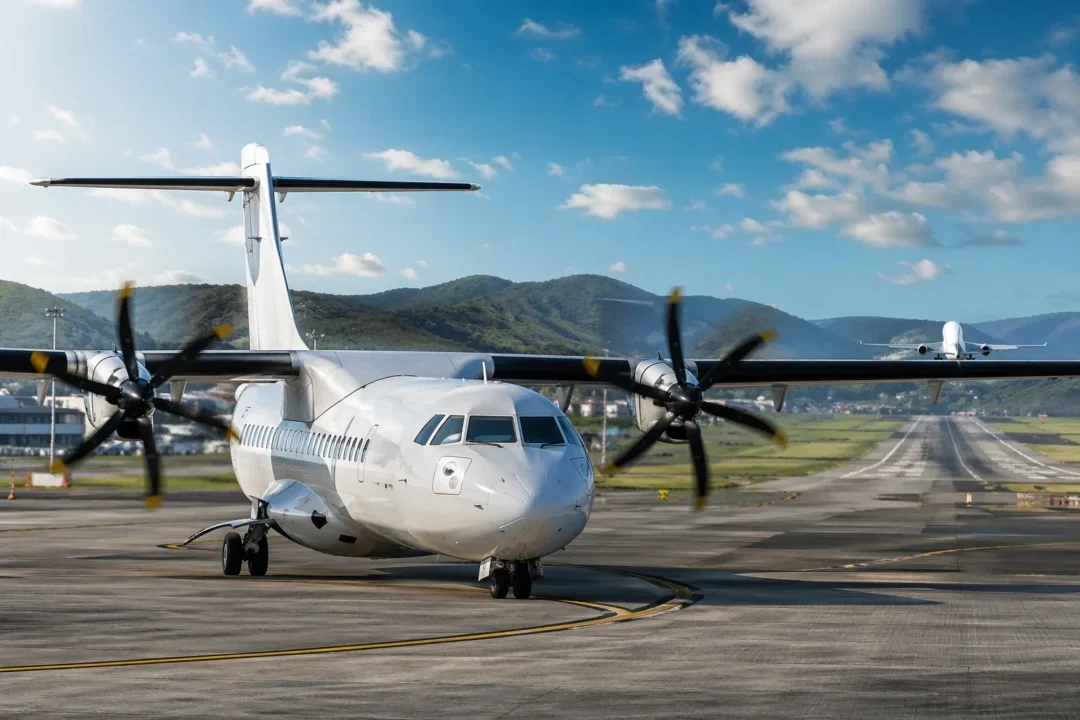
This is where turboprop aircraft become particularly relevant.
In this configuration, turboprops use a propeller driven by a gas turbine; more efficient at lower speeds and altitudes. This is the reality of many regional flights.
But those climb and descent phases are not at all marginal on routes commonly under 600 miles. They make up a significant fraction of the mission profile. Turboprops, on the other hand, will work more efficiently in this kind of environment.
Now, at first glance, the difference looks decent on a single rotation. As you drive from flight to flight over the course of many days, the effect becomes more pronounced.
Capacity and demand distribution
Lower seating capacity introduces a different approach to demand management.
Instead of concentrating passengers into a limited number of departures, airlines can distribute demand across several flights. This reduces the impact of variability and supports more stable load factors over time.
It also allows for greater scheduling flexibility, which remains a relevant factor for passengers traveling on regional routes.
Infrastructure considerations
Infrastructure limitations constrain operational decisions to a greater extent than is commonly considered.
Several regional airports have limitations on runway length, operating costs, or capacity. Flexibility has a clear advantage in such environments.
The turboprops can fly on less favorable conditions, such as operating to shorter or less advanced runways. It increases the reach of a network, facilitating connections that would otherwise be challenging to uphold.
Efficiency across repeated operations
On short-haul networks, efficiency emerges over time rather than from a single flight. On short routes, turboprops are 10%–60% more fuel-efficient than regional jets, depending on mission profile and load factors.
Modern turboprops like ATR turboprop aircraft specifically can achieve fuel consumption and CO₂ emission levels up to 45% lower than comparable regional jets. When these savings are applied across several daily rotations, their impact becomes structural.
At the same time, ongoing developments, including improvements in engine technology and the increasing use of Sustainable Aviation Fuel, continue to shape performance.
Passenger priorities in regional travel
Passenger behavior in regional aviation is influenced primarily by practical considerations.
Departure frequency, accessibility of the airport, and total travel time tend to play a more significant role than the aircraft itself. In many cases, scheduling flexibility becomes the determining factor.
A context-driven role
Jets don’t do Turboprops over to other route types for a reason.
They align better with operations for shorter routes, where demand varies throughout the day (and frequency matters).
The alignment is a key factor in overall efficiency for high-volume regional operations. Fleet decisions or more accurately, our fleet decisions, never state a parameter in determinism. Airlines generally evaluate aircraft performance over the course of a whole roster; consistency in repeated turns is frequently more important than top speed on an individual flight.