

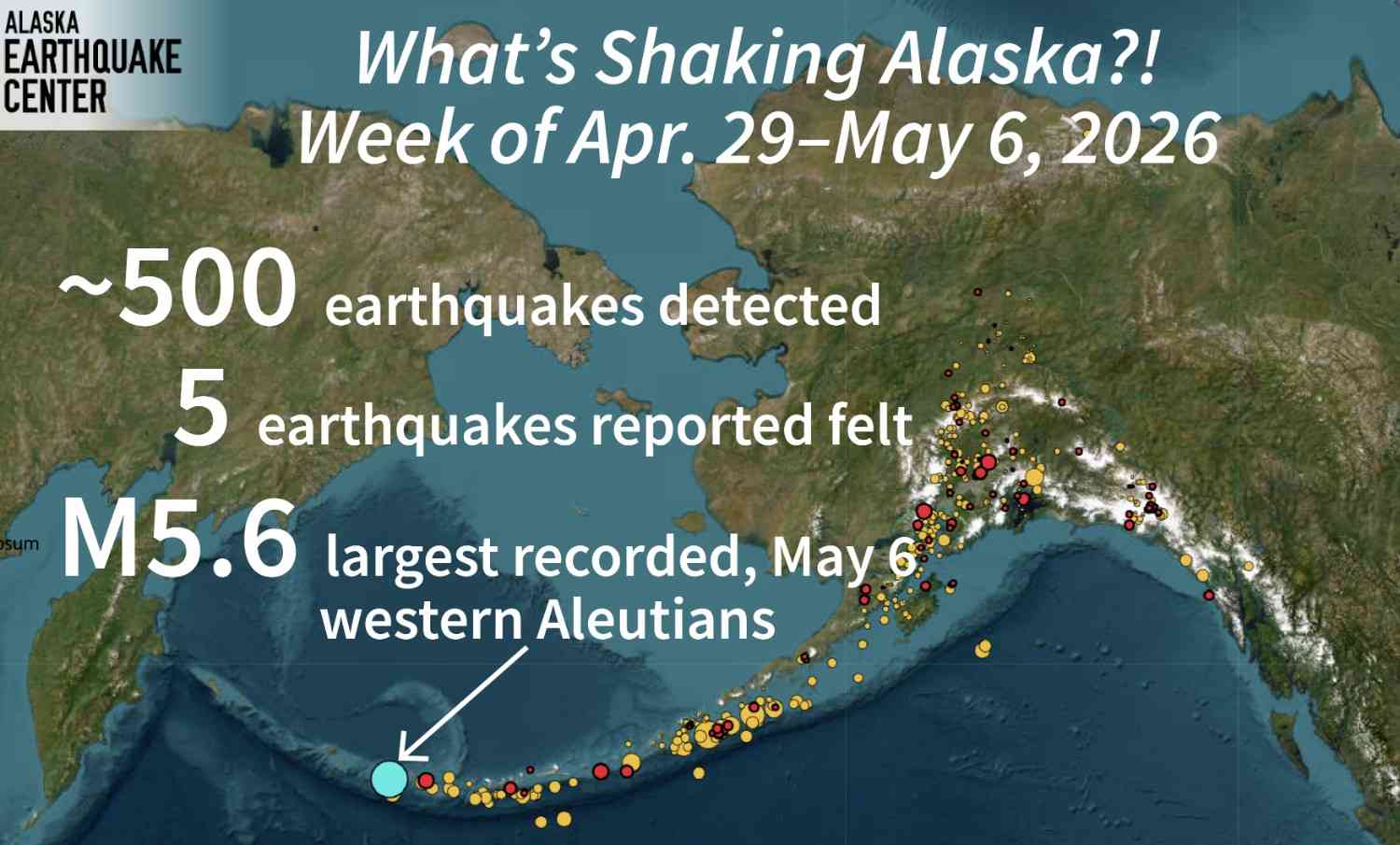
Alaska —Here’s your seismic update from across the state for the week of May 6, brought to you by the Alaska Earthquake Center, where we monitor ground shaking 24-7.
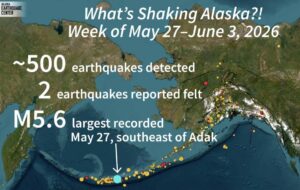
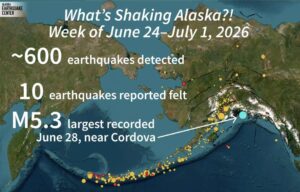
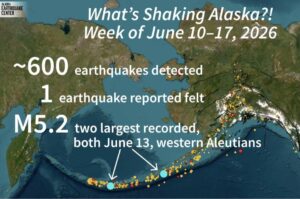
Over the past week, we recorded about 500 earthquakes. The largest was a magnitude 5.6 on May 6 in the westernmost Aleutian Islands, and five earthquakes were reported felt.
Two Earthquake Center researchers were authors on a paper published this week in the journal Science, summarizing what they learned from the massive August 2025 Tracy Arm landslide and tsunami in Southeast Alaska. Ezgi Karasözen does landslide monitoring research at the Earthquake Center.
“Landslides are common in the coastal mountains of Alaska. Tracy Arm offers new clues for how a landslide warning system could work,” she says.
A warning system could use a combination of weather, glacier activity, and seismic activity to generate alerts. The Earthquake Center developed a monitoring system that uses seismic waves so that within minutes of a large landslide, we can estimate the size and location of the landslide.
Also read: What’s Shaking Alaska: Weekly Earthquake Summary (May 27, 2026)
“We learned afterward that in the hours before the Tracy Arm landslide, seismic activity increased and transitioned to a continuous ‘hum’ of seismic energy, distinct from the landslide signal itself,” says Karasözen.
When the Tracy Arm seismic signal is sped up and converted to audio, it sounds like popping that changes to a buzz as the pace of seismic events picks up. The landslide sounds like a door slamming.
“Tracy Arm is giving us early clues about how to study these events and work toward warning systems that could alert ships and communities,” says Karasözen. For videos and the full story, visit earthquake.alaska.edu.