





Disclaimer: The information provided in this article is for general informational purposes only and should not be considered legal, financial, or professional advice. Readers should consult a qualified professional before making any business or legal decisions.
A surprising number of small businesses operate without any legal structure at all. No LLC, no registered business name, no separate bank account. Just a person getting paid who keeps putting off the official business registration.
For many, the reasons for these delays are simple enough. Registration costs money. It seems like a lot of steps. And if things are ticking along without a legal structure, it’s easy to convince yourself that the structure doesn’t matter yet. In fact, research from McKinsey shows that the informal economy remains large in many countries, largely because high registration costs, taxes, and regulatory burdens discourage many entrepreneurs from formalizing their businesses.
This is where most self-starters hit a wall they didn’t see. Plenty of resources explain how to create your own business from the ground up, but fewer people stop to ask what it actually costs to skip that step or to delay it for a year longer than they should.
Have questions about this story?
Ask Tundra for more details, context, or updates.
The Tax Situation Soon Gets Complicated
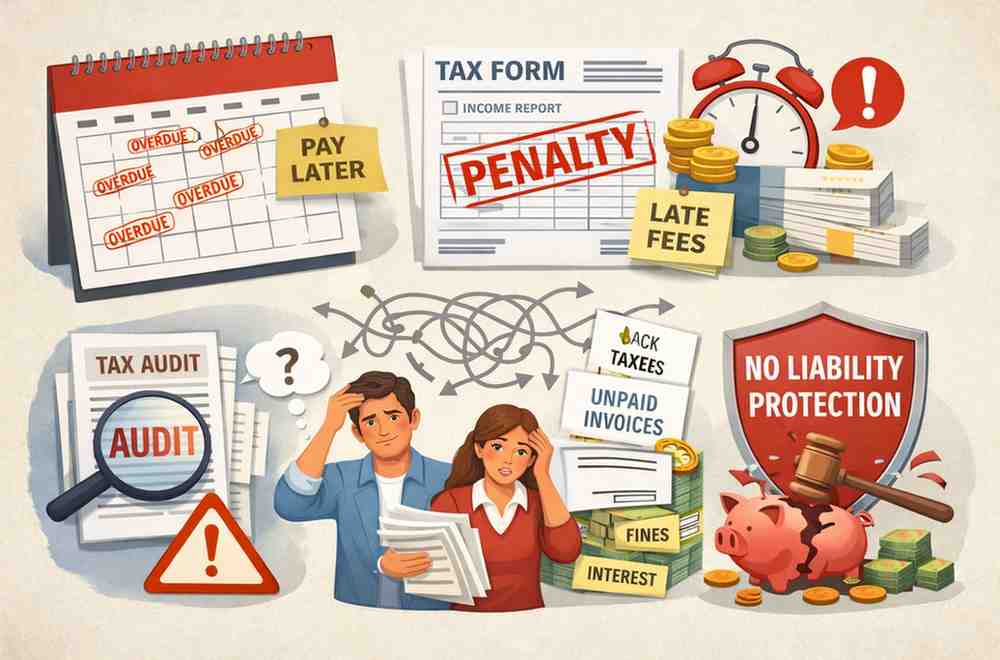
Staying informal doesn’t mean staying off the IRS’s list. The moment money changes hands regularly, tax obligations kick in
What the IRS Requires
Self-employment tax kicks in at 15.3% on net earnings the moment annual income from independent work exceeds $400. That covers Social Security and Medicare contributions that a traditional employer would otherwise split with the employee. This applies regardless of whether the person earning has a registered entity, a business name, or more than one client.
Also Read: Who is Eligible for Social Security Benefits?
On top of that, self-employed individuals who expect to owe $1,000 or more for the year are required to pay estimated taxes four times annually. Missing those payments triggers penalties on top of whatever is owed, penalties that compound each quarter they’re missed.
So, the lack of formal structure doesn’t lower the tax bill. It just removes the tools that could.
What Gets Left on the Table
Home office use, business equipment, professional services, and vehicle mileage are all legitimate deductions, but they’re harder to defend without a defined business structure and clean records to back them up.
The more organized the operation, the more defensible the numbers. Staying informal doesn’t mean staying untaxed. It often means paying more while being protected by less.
The Personal Liability Problem Is Real
When a business lacks a formal legal structure, the law treats the owner and the business as a single entity. That means every debt the business takes on and every dispute a client raises can flow back to the owner’s personal assets, savings, property, and vehicles.
If the business owes money and can’t pay, creditors can come after the owner’s personal assets. An LLC changes that equation by creating a legal barrier between the business and the individual, not an impenetrable one, but a meaningful one.
Without a separate legal entity, business debt is personal debt. Full stop. A dispute with a client, a contractor who gets hurt on the job, or a supplier who doesn’t get paid can reach a sole proprietor’s personal assets directly. Banks factor that in as well. An unregistered operation carries more perceived risk, and loan terms tend to reflect it
Also Read: Proven Strategies to Master Business and Company Debt Negotiation
Of course, an LLC doesn’t guarantee immunity from every legal outcome, but it reduces direct exposure.
How Clients and Partners Read Formality
There’s a practical cost to informality that doesn’t show up on a tax form. Suppliers, potential clients, and business partners often make quick assessments about who they’re dealing with, and a registered business with a professional domain, a business email address, and a verifiable legal name reads differently than a personal PayPal link and a Gmail account.
Why Delay Is More Expensive Than Action
Most people who delay formalization aren’t avoiding it forever; they’re just pushing it forward. The problem is that every month of operation without structure adds to the cost of catching up. Back taxes on unreported quarterly payments accrue interest. Business names get claimed by competitors. Contracts written without a legal entity can create ambiguities that take attorneys to untangle.
The comparison between acting early and acting late looks something like this:
| Factor | Formalizing Early | Delaying Formalization |
| Tax structure | Access to deductions from day one | Deductions less defensible; potential back payments |
| Personal liability | Protected by an LLC barrier from the first transaction | Full exposure on every transaction until formalized |
| Business credit | Eligible to build a credit history immediately | Starts from zero when finally registered |
| Contracts | Legally enforceable in the business name | May be unenforceable or require a personal signature |
| Domain & branding | Name secured before competitors claim it | Risk of losing preferred name or identity |
None of these is a worst-case-only scenario. They represent the ordinary, predictable cost of doing business without a legal home for it.
So, formalizing a business is not a bureaucratic milestone to reach when things get serious enough. Often, it is what makes things get serious in the first place.