




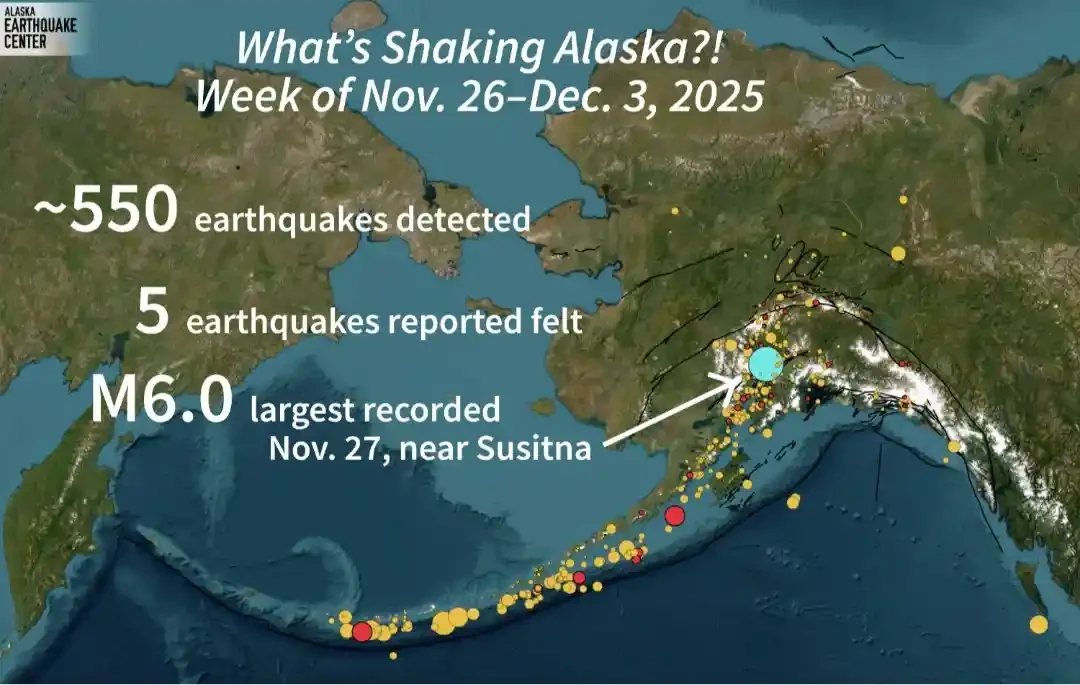
Here is your weekly seismic update from the Alaska Earthquake Center, where ground shaking is monitored around the clock. This week, about 550 earthquakes were recorded across the state.
The strongest happened on Thanksgiving morning, November 27, when a magnitude 6.0 earthquake struck near Susitna at a depth of 45 miles. People felt the shaking from Fairbanks all the way down to Homer, and reports lasted from a few seconds to nearly a minute. Only minor damage was reported.
Have questions about this story?Ask Tundra for more details, context, or updates.
Why was this earthquake so widely felt?
This event was not an aftershock of the 2018 Anchorage earthquake, but both happened for the same reason. As the Pacific Plate moves under the North American Plate, it bends and stretches deep underground. This stretching causes rocks to crack, triggering earthquakes like the 2018 Anchorage event and this week’s Susitna quake.
Because the Susitna earthquake occurred 45 miles below the surface, the shaking traveled easily through deeper, denser layers of the Earth. This made the shaking more evenly felt across a wide area, even far from the epicenter.
A timing coincidence
This earthquake happened just days before the anniversary of the 2018 Anchorage M7.1 earthquake, but there is no connection between the two. Deep earthquakes can happen at any time of year.
You can learn more about the Susitna earthquake and see maps and data at earthquake.alaska.edu.
Felt Earthquakes This Week
- Nov 27: M6.0 Susitna (felt Fairbanks to Homer/Valdez)
- Nov 27: M2.9 aftershock (54 “Did You Feel It” responses)
- Nov 27: M3.2 aftershock (22 responses)
- Dec 1: s (a few felt reports; USGS lists M5.1)
- Dec 1: M4.0 Sand Point (felt locally)