




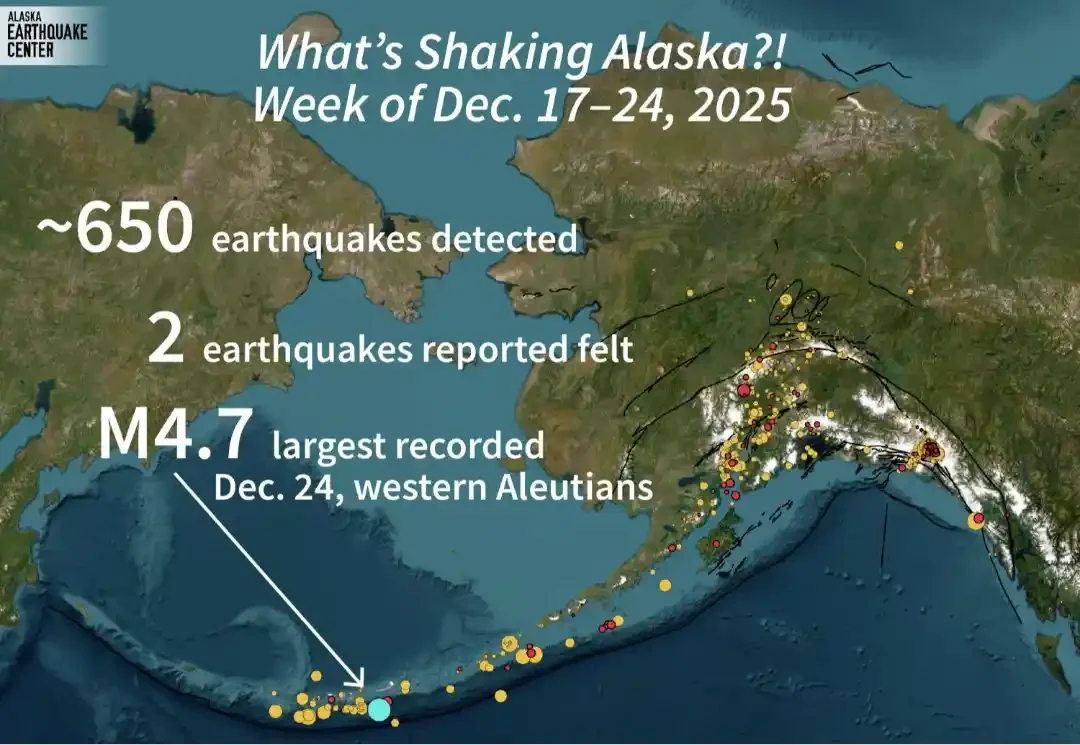
Here is your weekly seismic update from the Alaska Earthquake Center for Christmas Eve, where earthquake activity is monitored 24 hours a day.
Over the past week, Alaska recorded about 650 earthquakes. The largest was a magnitude 4.7 earthquake in the western Aleutian Islands. The second largest, a magnitude 4.6 near Yakutat, was an aftershock of the magnitude 7.0 Hubbard Glacier earthquake that struck on December 6.
Have questions about this story?
Ask Tundra for more details, context, or updates.
Why Aftershocks Are Decreasing
Aftershocks from the Hubbard Glacier earthquake are still happening, but their number and strength are slowly decreasing. This is a typical pattern after a large earthquake.
Also Read: What’s Shaking Alaska?Weekly Earthquake Summary (December 17, 2025)
Earthquakes release stress that builds up over time along faults in the Earth’s crust. When a major quake occurs, some of that stress shifts to nearby areas, causing aftershocks.
Scientists follow a well-known pattern called Omori’s Law, which explains how aftershocks behave. Right after a large earthquake, aftershocks are frequent and stronger, but over time, they become less common and weaker. Seismologists use this pattern to estimate how many aftershocks may occur following a significant event.
Stay Informed
The Alaska Earthquake Center continues to monitor the Hubbard Glacier earthquake sequence and other seismic activity across the state.
More information, maps, and updates are available at earthquake.alaska.edu.