



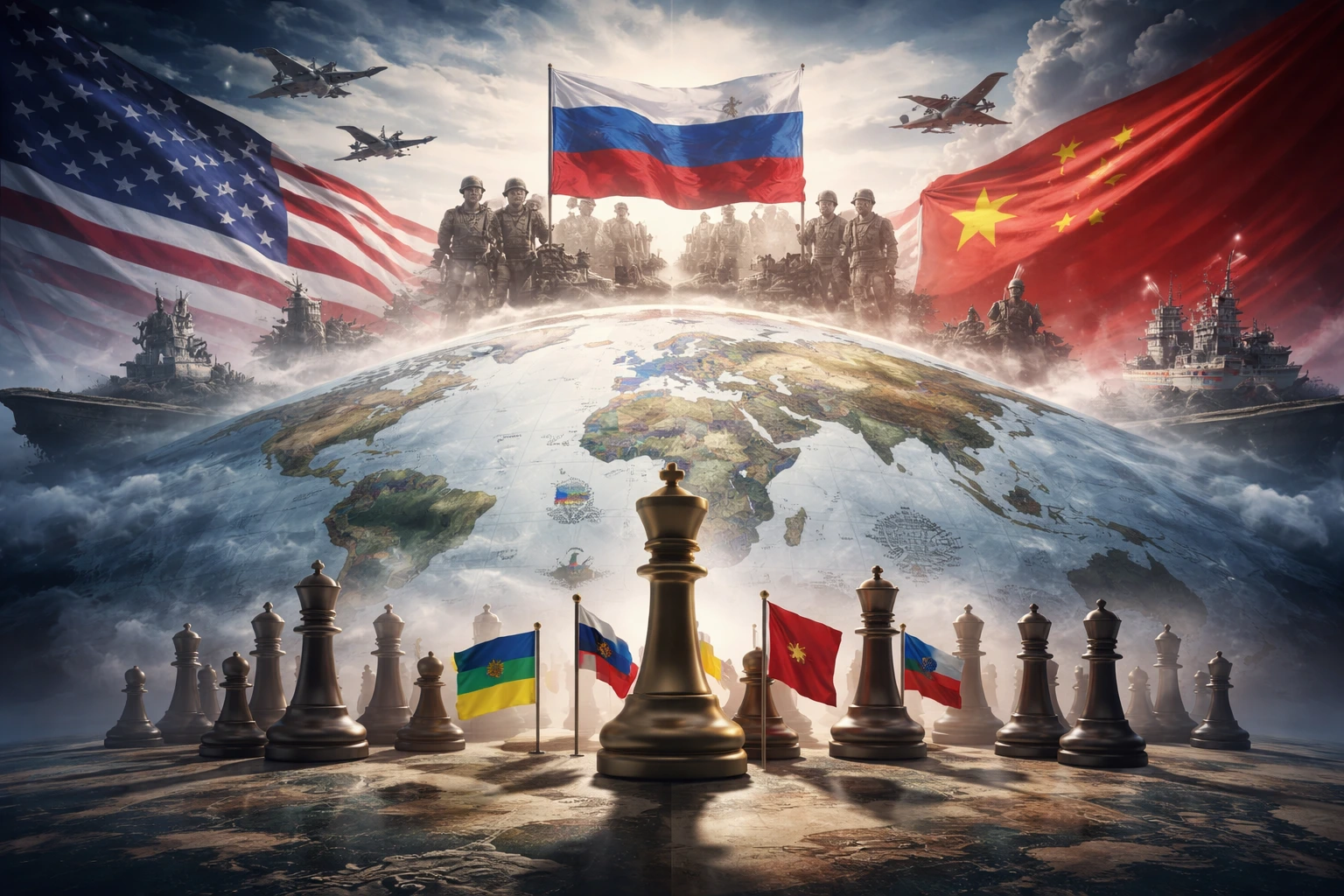
Superpower involvement in smaller countries is not an anomaly. It is a structural feature of international politics.
From Cold War proxy contests to modern economic conditions, powerful states have repeatedly influenced the political direction of smaller nations. The methods have evolved, but the motivations remain consistent: security, economic stability, resource access, technological dominance, and balance-of-power calculations.
The ongoing tensions in the Middle East in 2026, including escalations involving Iran, the United States, and Israel, illustrate how smaller or regionally powerful states can become central arenas of global strategic competition.
To understand why this happens, we must look beyond individual conflicts and examine the deeper logic of global power behavior.
Have questions about this story?
Ask Tundra for more details, context, or updates.
The Core Logic: Power, Security, and Survival
At its foundation, superpower interference is driven by security.
International relations scholars often describe the global system as “anarchic,” meaning there is no central authority above sovereign states. In such a system, powerful nations prioritize survival, influence, and deterrence.
When a smaller country’s political alignment shifts, it can alter:
- Military balance in a region
- Access to key trade routes
- Resource security
- Alliance structures
- Technology supply chains
From this perspective, interference is often framed as defensive even when it appears aggressive.
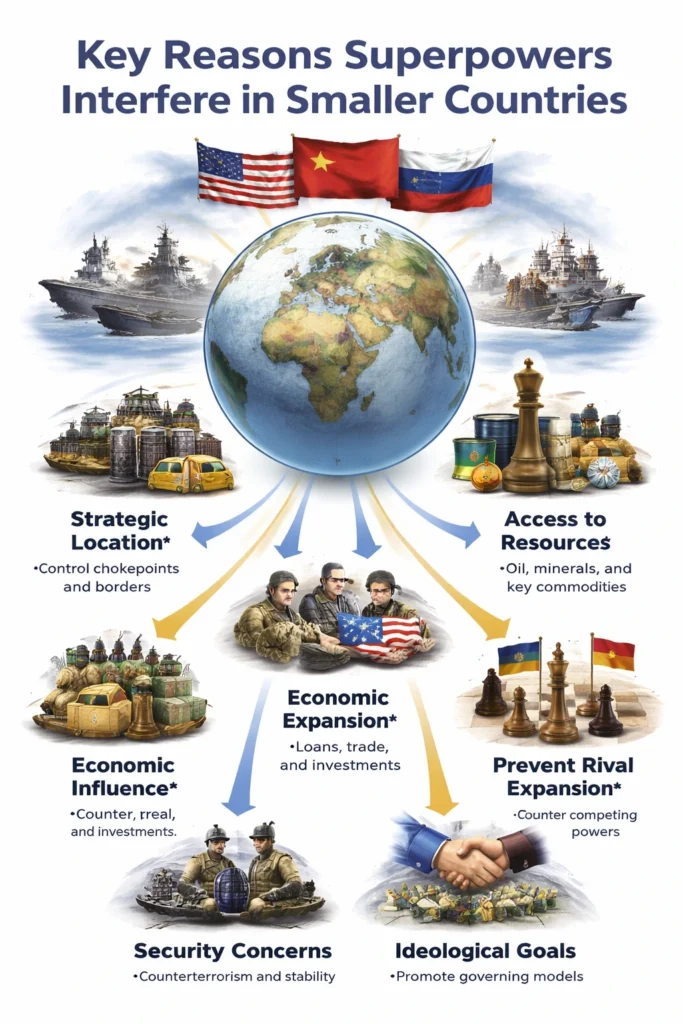
Strategic Geography Still Determines Political Importance
In 2026, geography remains destiny.
Smaller nations positioned near:
- Maritime chokepoints
- Energy transit corridors
- Rival military borders
- Technology hubs
carry disproportionate strategic weight.
For example:
- Nearly 90 percent of global trade moves by sea.
- Around one-fifth of the global oil supply passes through the Strait of Hormuz.
- Major semiconductor production remains concentrated in a small number of territories.
When political instability threatens these nodes, superpowers respond diplomatically, economically, or militarily.
This is not new. What has changed is the scale of global interdependence.
Resource Security in the Age of Energy Transition
Interference is not only about oil.
In 2026, geopolitical competition increasingly centers on:
- Lithium for electric vehicle batteries
- Rare earth elements for electronics
- Cobalt for advanced technologies
- Semiconductor fabrication
Control over these supply chains shapes economic power.
When a smaller country controls critical resources, external influence often follows.
Economic conditions, through loans, trade agreements, sanctions, or infrastructure investment, become a tool of political shaping.
The Economic Architecture of Influence
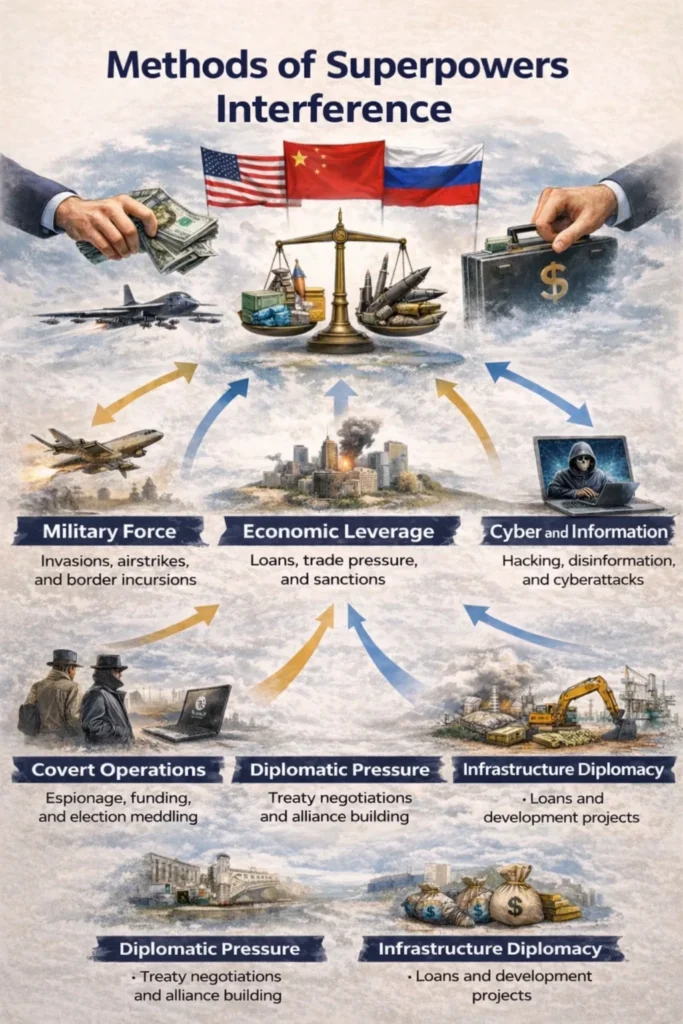
Modern interference frequently operates through economic systems rather than tanks.
Global powers use:
- Sanctions regimes
- Trade restrictions
- Conditional financing
- Infrastructure partnerships
- Development aid
More than 30 countries currently face some form of economic sanctions globally.
Global defense spending exceeds 2 trillion dollars annually, while international infrastructure commitments reach into the hundreds of billions.
Economic pressure can influence:
- Electoral outcomes
- Policy reforms
- Trade alignment
- Military cooperation
In today’s world, influence often flows through financial systems.
Preventing Rival Expansion: The Balance-of-Power Principle
Superpowers do not operate in isolation. They respond to each other.
If a smaller country aligns more closely with one major power, rival powers may act to counterbalance that shift.
This dynamic is visible in:
- Eastern Europe
- The Middle East
- The South China Sea
- Parts of Africa
The Russia–Ukraine war, tensions involving Iran and Israel, and growing competition in East Asia all demonstrate how smaller states can become focal points of broader strategic rivalry.
These situations are less about the smaller country alone and more about what its alignment represents.
The Iran–US–Israel Tensions in 2026: A Case Study in Strategic Significance
The current tensions involving Iran, the United States, and Israel reflect multiple overlapping motivations:
- Regional security calculations
- Deterrence and missile capability concerns
- Energy transit security
- Alliance commitments
- Power signaling
Iran’s geographic location near major energy corridors elevates its strategic importance. Regional military alliances and proxy relationships further amplify its geopolitical role.
When military strikes, cyber operations, or sanctions occur, they reflect a broader effort to shape strategic balance rather than isolated hostility.
This pattern illustrates how even non-superpower states can become central in superpower calculations.
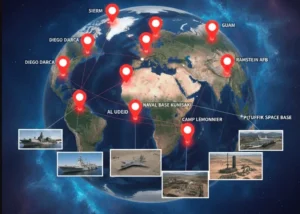
Also Read: Most Strategic Military Bases Globally 2026: Overseas, Secret, and Powerful Sites
Cyber and Information Warfare: The New Arena
Interference in 2026 increasingly includes digital dimensions.
Cyber operations may involve:
- Infrastructure disruption
- Election interference attempts
- Information campaigns
- GPS and communications interference
These methods:
- Require fewer resources than traditional military operations
- It’s harder to attribute
- Can scale globally
Hybrid warfare, combining economic, cyber, diplomatic, and limited military tools, now defines modern influence strategies.
Also Read: Proxy Wars 101: History, Tactics, and Modern-Day Examples
Why Smaller Countries Remain Vulnerable
Smaller nations often face structural constraints:
- Limited defense budgets
- External debt exposure
- Economic concentration in a few exports
- Political fragility
When external powers provide financial or military support, influence relationships may deepen.
However, many smaller countries actively pursue strategic balancing, maintaining relationships with multiple powers to avoid overdependence.
This balancing strategy has become increasingly important in a multipolar world.
The Shift from Unipolar to Multipolar Competition
After the Cold War, the global system briefly appeared unipolar. Today, it is increasingly multipolar.
Multiple major powers compete simultaneously across:
- Technology
- Energy
- Military modernization
- Trade routes
- Infrastructure networks
In this environment, smaller countries are not passive victims, but they often become arenas where influence is contested.
Superpower interference is therefore not an exception to global politics; it is a recurring feature of it.
Is Interference Always Negative?
The outcomes of interference vary.
Some interventions are framed as:
- Stabilization efforts
- Peacekeeping missions
- Counterterrorism cooperation
Others are criticized as:
- Sovereignty violations
- Destabilizing actions
- Strategic coercion
The impact depends on:
- Intent
- Method
- Duration
- Local institutional strength
History shows both stabilizing and destabilizing outcomes.
Also Read: How Drones Are Changing Modern Warfare Forever?
Thought Leadership Perspective: The Structural Reality
The key insight is this:
Superpower interference is not random. It follows predictable patterns tied to power, security, and economic systems.
In 2026, rising tensions in the Middle East, ongoing war in Eastern Europe, and strategic competition in Asia all reflect the same structural drivers.
As long as global power disparities exist, interference, whether military, economic, or digital, will remain part of international relations.
The form changes.
The logic does not.
Final Insight
Understanding why superpowers interfere requires moving beyond individual headlines and examining the underlying system.
Smaller countries matter not because they are weak, but because their geography, resources, alliances, and political orientation shape the broader balance of global power.
In an interconnected world, local politics can carry global consequences.
That reality explains why powerful nations continue to intervene directly or indirectly in the political affairs of smaller states.
FAQs
Why do superpowers interfere in smaller countries?
Superpowers interfere in smaller countries to protect strategic interests, secure access to resources, prevent rival influence, and maintain regional or global power balance.
Is foreign political interference legal under international law?
International law emphasizes state sovereignty and non-interference. However, enforcement is complex, and political, economic, and diplomatic influence often exists in legal gray areas.
Does interference always involve military invasion?
No. Modern interference is often economic or political rather than military. It may involve sanctions, trade leverage, infrastructure investment, cyber influence, or diplomatic pressure.
Why are smaller countries more vulnerable to interference?
Smaller countries may have limited military capacity, economic dependence, or strategic geographic locations, which can make them more susceptible to external influence.
Has foreign interference increased in recent years?
Direct military interventions have declined compared to the 20th century, but economic leverage, cyber influence, and strategic competition have increased in the 21st century.
How does the Russia–Ukraine war relate to superpower interference?
The conflict reflects broader geopolitical tensions over security alliances, regional influence, and strategic positioning. Ukraine’s location and political alignment have made it central to larger power competition.
Why is Taiwan often mentioned in discussions about global power competition?
Taiwan plays a significant role in global semiconductor production and sits in a strategically sensitive region, making its political stability important to major powers.
Can smaller countries resist superpower influence?
Yes. Many smaller nations balance relationships between major powers, strengthen regional alliances, diversify trade partnerships, and build strong institutions to maintain autonomy.
Does economic aid count as political interference?
Economic aid itself is not necessarily interference. However, when aid or loans come with political conditions or strategic expectations, they can influence domestic decision-making.
Is superpower interference always negative?
Outcomes vary. Some interventions are framed as security or stabilization efforts, while others are criticized for undermining sovereignty. The long-term impact depends on context and execution.