




Picking an SEO tool shouldn’t feel this complicated. SEMrush, Ahrefs, and Moz have been competing for the same audience for years, and all three do enough overlapping things that comparing them on paper starts to feel circular fairly fast.
What actually separates them isn’t the feature list, it’s which features are done well, how much effort it takes to extract useful information, and whether the pricing makes sense for the kind of operation someone is running. No winner gets declared here. The right tool depends entirely on the situation.
Have questions about this story?Ask Tundra for more details, context, or updates.
The Three Tools at a Glance
SEMrush (2008) expanded from an SEO tool into a full digital marketing platform covering paid search, social media, content planning, and PR alongside its core SEO features. Ahrefs (2010) grew out of backlink analysis as its link index is still what SEO professionals mention first, even though the platform now covers far more. Moz (2004) introduced Domain Authority, a benchmark that remains widely used in link building and content circles, and built its name as much on SEO education as on its toolset.
How Bloggers Actually Use These Tools
Before getting into specifics, it helps to be clear about what content-focused users actually need. Most bloggers work across four areas: finding keywords worth writing about, tracking competitor rankings, understanding backlink profiles, and running occasional audits to catch technical issues. The gaps between these three tools across those areas are meaningful enough to affect the decision.
Feature-by-Feature: Where Each Tool Stands
Keyword Research
SEMrush has one of the larger keyword databases, and the Keyword Magic Tool is useful for long-tail discovery and sorting by intent i.e. commercial, informational, navigational. That intent layer helps bloggers decide not just what to write about, but whether a keyword is worth the effort at all.
Ahrefs approaches keyword value differently through its Traffic Potential metric, which estimates how much traffic the top-ranking page actually gets rather than just the volume of the keyword itself. For prioritization decisions, that tends to be a more honest number.
Moz Keyword Explorer covers the basics and has added intent signals in recent updates. Its database is smaller, which shows up when researching niche or long-tail terms. For bloggers in well-established verticals it’s generally sufficient; for those in narrow niches, the gaps can be frustrating.
Content and Blog SEO Features
This is where SEMrush pulls ahead most clearly for editorial teams. The SEO Content Template generates a pre-writing brief based on what’s already ranking, recommended word counts, semantic terms to include, readability benchmarks. For teams publishing multiple posts a week, having that scaffolding in the workflow saves real time.
Ahrefs Content Explorer is useful for ideation and competitive research, surfacing high-performing articles across billions of indexed pages. The AI Content Helper scores drafts against top-ranking pages. Where it falls slightly short is in day-to-day writing workflow as it’s better at pointing toward good ideas than helping execute them.
Moz handles on-page optimization and keyword targeting competently but doesn’t match the content workflow depth of the other two. It’s better suited for auditing existing pages than guiding what to create next.
Backlink Analysis
Ahrefs built its reputation here and still holds it, 64% of SEO professionals trust Ahrefs’ link data over its competitors, according to Aira’s State of Link Building Report. Its index is updated with fresh data every 15 minutes where new links get picked up quickly, lost links surface clearly, and historical data goes back years. For bloggers doing serious link building or outreach work, it’s difficult to replace.
SEMrush offers a solid backlink suite and its Backlink Gap tool, which compares link profiles across multiple competitors simultaneously, is one of the more practically useful features in this category. Its index is smaller than Ahrefs but still covers well beyond what most bloggers need. Moz Link Explorer works fine for basic profile monitoring and integrates Domain Authority naturally, but shows its limitations in deeper competitive research.
Ease of Use
Moz is the most beginner-friendly with its straightforward interface, plain-language tooltips, and a support ecosystem built with newer users in mind. The onboarding friction is noticeably lower than either alternative.
Ahrefs has improved its interface significantly and most users find it intuitive once they’ve spent a few sessions inside it. Key metrics surface clearly without requiring much navigation.
SEMrush is the most complex to get comfortable with, simply because there’s more to navigate. That depth is a genuine advantage for experienced teams but can feel overwhelming initially. SEMrush Academy provides solid free training that softens the curve, but the time investment is real.
Reporting
SEMrush produces the most polished and customizable reports, a real advantage for agencies presenting to clients. Ahrefs keeps reporting clean and data-dense, better for internal use than packaged client exports. Moz keeps it simple and readable, which suits solo bloggers and small teams well.
Best Fit by Use Case
- Beginner bloggers: Moz. Lower cost, gentler learning curve, 30-day trial.
- Content-heavy editorial teams: SEMrush. Content workflow tools, intent filtering, and reporting depth suit consistent publishing.
- Link building and backlink-focused work: Ahrefs. Index size and update speed are why it stays in serious SEO stacks.
- Agencies or multi-site teams: SEMrush or Ahrefs, depending on whether content workflow or backlink depth comes first.
Pricing: What to Know Without Getting Into the Weeds
SEMrush and Ahrefs sit at comparable entry-level price points, both in the premium tier. Moz is generally more affordable. Ahrefs moved to a credit-based model for certain reports, which can push costs higher for heavy users than the base price suggests. SEMrush’s entry plan limits tracked keywords and projects. Moz offers a 30-day free trial, SEMrush offers 7 days, and Ahrefs currently has no free trial.
Strengths and Limitations: The Honest Version
SEMrush The breadth is genuinely impressive with keyword research, content workflow, backlink analysis, site audits, rank tracking, and competitor research all in one place. For teams that need to manage multiple channels of digital marketing without bouncing between platforms, that consolidation has real value. The content toolkit in particular is difficult to match. On the downside, SEMrush is the most expensive of the three at higher tiers, the interface takes time to navigate efficiently, and some features feel surface-level compared to tools that do only that one thing. It can also feel like paying for a lot of functionality that never gets used.
Ahrefs The backlink index is the strongest in the industry, and the organic search data with keyword difficulty scores, traffic estimates, and SERP history is consistently reliable. For bloggers who take link building seriously or want to understand exactly why a competitor is ranking, it’s the most trustworthy source. The limitation is that Ahrefs is less well-rounded than SEMrush on the content and marketing side, and the move to a credit-based model for certain features has made the actual cost of heavy use less predictable. It also lacks a free trial, which makes it harder to evaluate before committing.
Moz Accessibility is Moz’s clearest strength as it’s the easiest entry point into paid SEO tooling, and for bloggers who are still developing their SEO knowledge, the educational layer built into the product is genuinely helpful. The Domain Authority metric gives a quick and widely understood benchmark for evaluating sites and link prospects. The limitations are real though: the keyword database is smaller, the content workflow tools are limited, and for anyone whose SEO work goes beyond the fundamentals, Moz tends to get outgrown. It’s a solid starting point, less so a long-term platform for serious SEO teams.
Before Committing to Any of Them
None of these tools make sense as an opening move. A content strategy, a publishing cadence, and a working understanding of search intent should already be in place. A tool accelerates the strategy, it doesn’t create it.
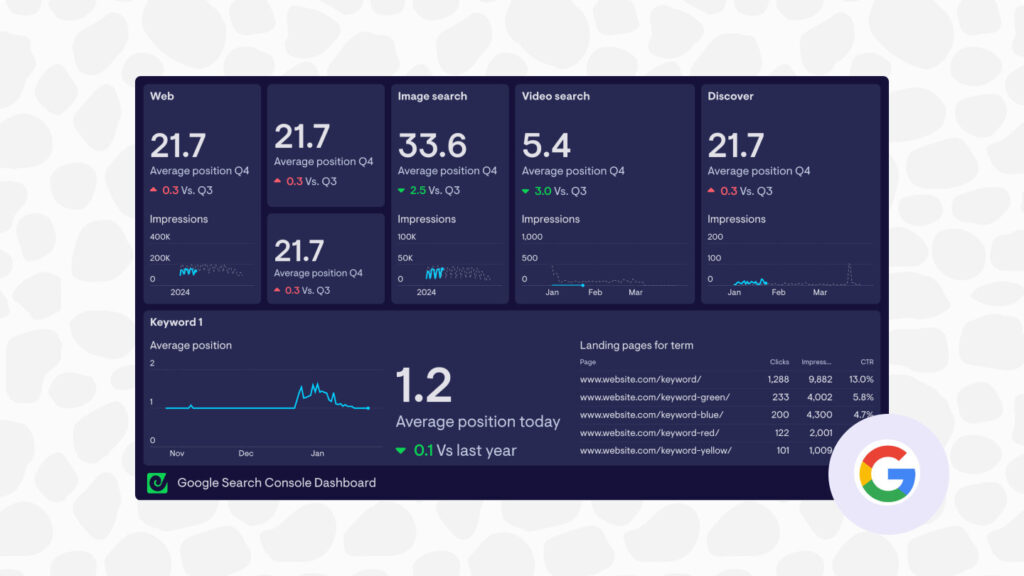
Free tools like Google Search Console and Google Keyword Planner cover more than most early-stage blogs need. Paid tools start earning their keep when a site already has traction and the goal is systematic growth. Testing whatever trial is available against actual daily workflows, not hypothetical ones, is the most reliable way to figure out which fits.
Credit: geckoboard.com
The Bottom Line
SEMrush suits teams who need breadth: content workflow, keyword intent, broad reporting. Ahrefs suits those who live in organic search data and backlink research. Moz suits individuals and smaller operations wanting solid fundamentals at lower cost and complexity. Whichever direction you go, pairing your chosen tool with AI SEO tools can further strengthen your content strategy.
There’s no universally right answer here, only the one that fits the actual situation.