





Disclaimer: This article is for general informational purposes only and should not be taken as legal, compliance, tax, or financial advice. Practice transitions can involve regulatory obligations, privacy requirements, and client-consent considerations. Consult qualified professionals for your situation.
Selling a financial advisory practice isn’t like selling a generic service business.
On paper, you’re transferring revenue. In real life, you’re transferring relationships built over years of phone calls, market jitters, life events, and tough conversations that clients trusted you to handle.
That’s why most practice sales don’t fall apart because of price. They fall apart because of uncertainty: buyers can’t verify retention, sellers don’t want to spook clients, and everyone’s trying to move fast while compliance demands you slow down.
And timing matters more than most advisors realize. As Forbes highlights, effective exit planning should begin years before a sale or transition. Advisors who prepare early tend to achieve better outcomes, smoother client transitions, and stronger valuation positions.
If you’re thinking about an exit, or even just planning for one, here’s a practical, readable framework you can actually use. A process that combines classic sales structure with the realities of advisory transitions.
Have questions about this story?
Ask Tundra for more details, context, or updates.
Why a sales process matters in a practice sale
A practice sale can feel like a single big decision, but it’s really a sequence of smaller decisions, each one requiring clarity:
- Are you truly ready to sell, or just burned out?
- Is your revenue transferable, or dependent on you personally?
- What does a buyer need to see before they’ll commit?
- How do you protect clients while making the transition real?
A structured process helps you avoid skipping steps, especially those that protect value. Think of it as a 5-step practice sale process you can repeat, refine, and document long before you’re ready to announce anything.
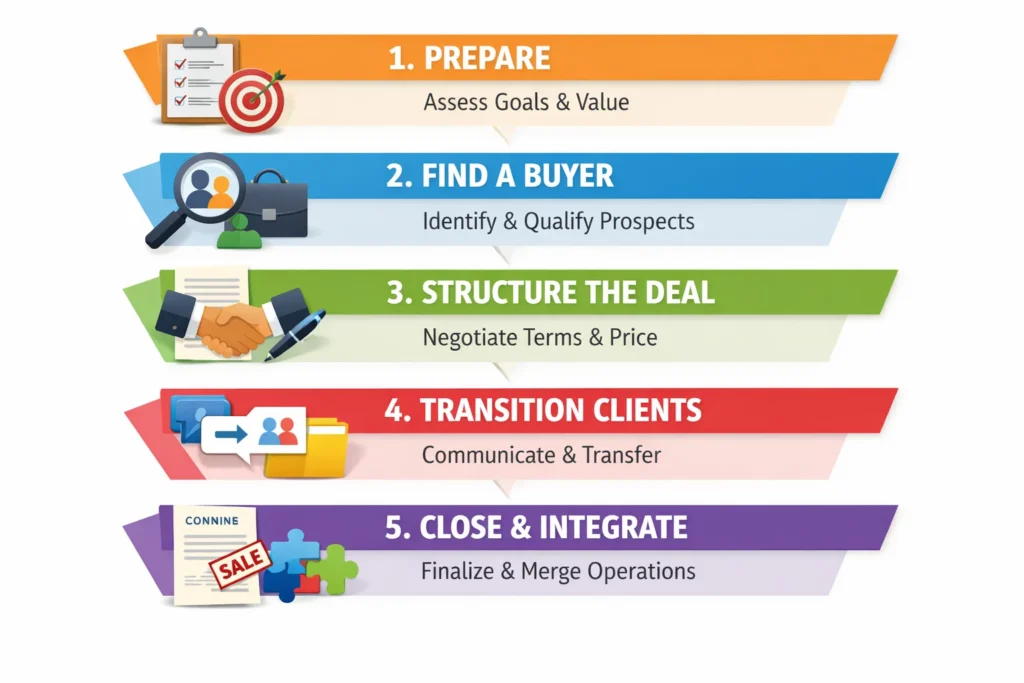
Step 1: Prospecting (Yes, even when you’re the seller)
Most financial advisors hear “prospecting” and think outbound leads. In a practice sale, prospecting means identifying the right buyer before you ever discuss terms.
Also Read: Exploring the Role of Advisor-Friendly Trusts in Financial Planning
Not every buyer is a fit for your clients. And not every buyer deserves your book.
Start by defining your non-negotiables:
- Client experience: Will your clients get the same (or better) service model?
- Investment philosophy: Planning-first? Product-agnostic? Tax-heavy?
- Client profile match: Age bands, AUM ranges, complexity, business owners, and retirees.
- Timeline + transition style: Fast close vs phased handoff.
Then build a shortlist through credible channels, firms, networks, and specialists who facilitate advisory transitions and buyer matching. If you’re mapping your own 5-step practice sale process, start by listing the buyer traits that protect client experience first, and valuation second.
Goal of Step 1: Create a shortlist of buyers who match your clients and your transition preferences (not just your price expectations).
Step 2: Qualification (Protect your time and your confidentiality)
This is where many sellers get sloppy because the attention feels flattering.
But qualification is what keeps you from wasting months with a buyer who can’t close, can’t finance, or can’t retain.
You’re looking for proof of:
- Capacity: Operational bandwidth to absorb clients
- Compatibility: Service model alignment and staffing
- Capability: Demonstrated retention and onboarding process
- Capital: Ability to fund the deal structure
Practical qualification questions (kept professional, not interrogative):
- What’s your typical onboarding timeline for new households?
- How do you handle service continuity in the first 90 days?
- What’s your retention history in previous transitions (if applicable)?
- How would you structure the transition communication?
- What’s your preferred deal structure and why?
Goal of Step 2: Confirm you’re talking to a serious, viable buyer before you open the hood. In a robust 5-step sales process, this is the gate that protects your time, your staff, and your client relationships.
Step 3: Discovery (Due diligence before valuation fights)
In classic sales frameworks, discovery is about pain points. In a practice sale, discovery is about risk, and the cleaner you make it, the more confident offers become.
Think of discovery in three layers:
Layer A: Business fundamentals
- Revenue composition (recurring vs variable)
- Household concentration risk
- Service tiers and margins
- Staffing and process documentation
Layer B: Client transferability
- How relationship-dependent is the book?
- Who are the “anchor relationships” that influence others?
- What client concerns commonly arise (fees, philosophy, communication)?
Layer C: Compliance and continuity realities
This is where you move carefully: client data, confidentiality, consents, representations, these can’t be improvised.
At a high level, investment advisers operate under a fiduciary standard and obligations to act in the client’s best interest and provide full and fair disclosure. That’s one reason buyers will scrutinize how you’ll transition clients (and why you’ll want professional guidance specific to your circumstances).
Recent industry benchmarking shows that average client retention for registered investment advisory practices is approximately 97%, reflecting the stability and trust that typically characterize these relationships in fiduciary advisory models. Because retention is a critical driver of valuation, buyers will closely evaluate transfer risk, communication strategy, and your plan to maintain continuity after the sale.
Goal of Step 3: Surface risks early, document strengths clearly, and reduce the unknowns that lower offers. When your 5-step practice sale process is documented, buyers don’t have to guess, and you don’t have to “sell” as hard.
Step 4: Present the deal (Structure, not hype)
This is the step where sellers often unintentionally become promotional, over-selling the “upside,” downplaying concentration, or treating the buyer like a competitor.
A better approach: present a clean, structured case that helps the buyer confidently say “yes.”
What to include in your deal story:
- A simple narrative: how the practice was built, how it runs today, why it’s stable
- Clear segments: client types, service levels, common planning needs
- Operational playbook: meeting cadence, review workflow, communication rhythms
- Transition plan: your personal involvement post-close and how you’ll introduce the buyer
Keep the conversation anchored in outcomes
Instead of:
“This book has huge growth potential.”
Say:
“Here’s what we consistently do that keeps retention high: review cadence, response standards, and proactive planning prompts.”
You’re not selling dreams, you’re selling continuity.
Goal of Step 4: Present a transition that feels safe for clients and operationally realistic for the buyer.
Step 5: Close and follow through (Where value is protected or lost)
Closing is not a signature. It’s a sequence:
- Agreement on structure
- Agreement on terms
- Agreement on transition communication
- Execution of the handoff
- Retention monitoring
This final step is where deals either succeed quietly… or unravel loudly.
What good follow-through looks like
- Client-first messaging: Calm, clear, and consistent
- Joint meetings where needed: Especially for top households
- Defined service continuity: Who does what, when, and how
- Retention checkpoints: 30/60/90-day check-ins and tracking concerns
- A handoff that feels human: Not transactional
If you’re staying on in any capacity (even informally), be specific. Vague promises create future friction.
Goal of Step 5: Stabilize retention, reduce anxiety, and ensure the deal works beyond closing day. This is where a 5-step practice sale process proves it’s more than a checklist, it’s a client experience plan.
Common mistakes that quietly lower your sale value
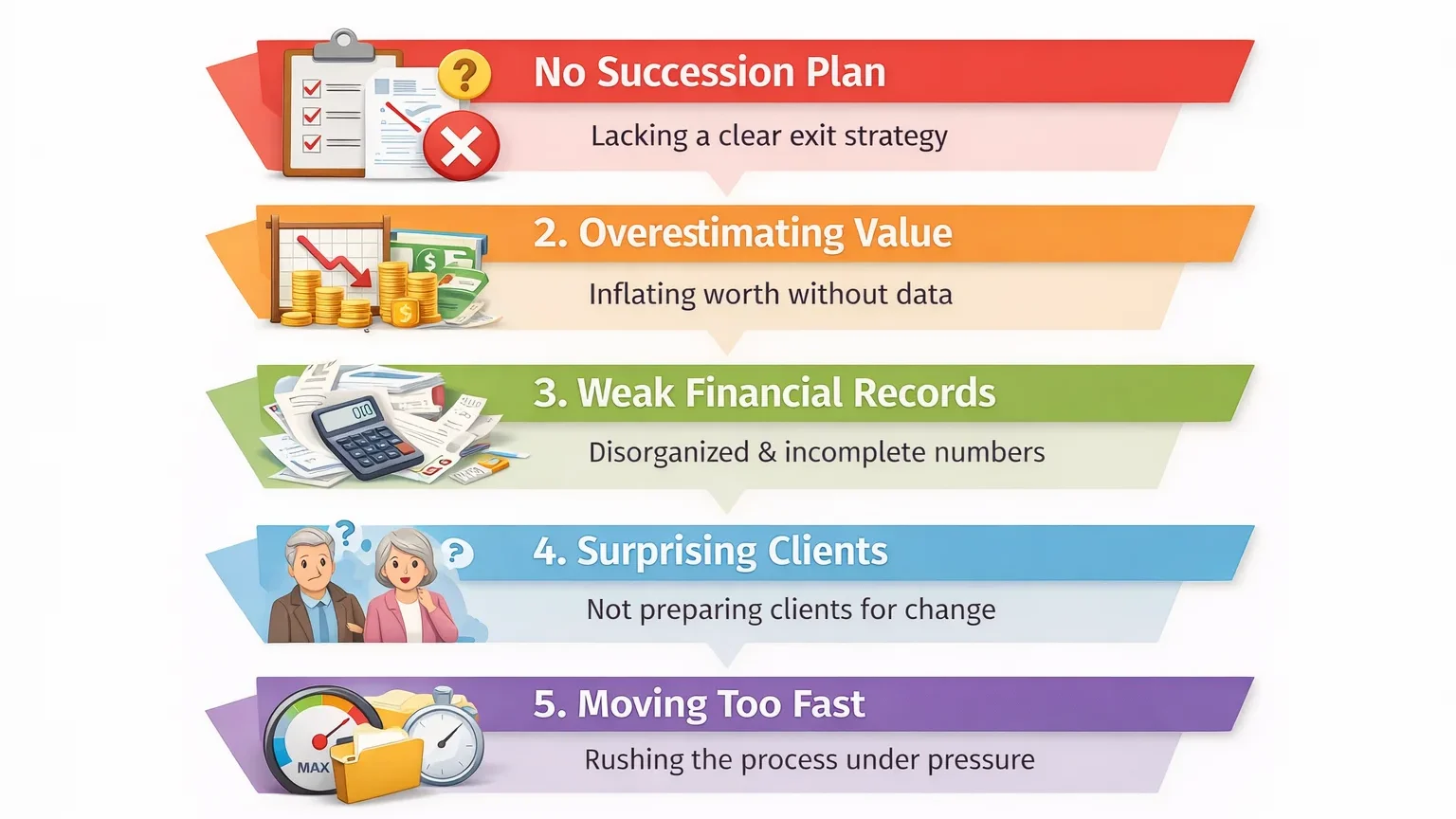
Treating the sale like a pricing negotiation
Price matters, but buyers are willing to pay more when they trust the vendor to protect their data.
Waiting too long to document the process
If “only you know how it works,” your book is riskier than it looks.
Overexposing clients too early
You need a communication timing plan so clients feel respected, not surprised.
Ignoring the emotional side
Clients aren’t assets. They’re people. And people need reassurance, not announcements.
Final thoughts: Your exit is part of your legacy
A practice sale isn’t just an endpoint. It’s the last service you provide your clients.
When you follow a clear, respectful process of prospecting, qualification, discovery, presenting the deal, and follow-through, you don’t just protect valuation. You’re running a 5-step practice sale process designed to preserve confidence at every handoff point. You protect trust.
And in the advisory world, trust is the real premium.