





Disclaimer: This article is for informational purposes only and does not constitute financial, legal, or investment advice. Readers should evaluate software solutions based on their own requirements and consult qualified professionals before making decisions.
Selecting software for private equity operations is far more than a technical upgrade. It is a strategic choice that directly influences reporting accuracy, operational efficiency, regulatory compliance, and investor confidence. Private equity firms operate in an environment of complex fund structures, diverse investor agreements, and increasing transparency requirements. Relying on manual processes or poorly suited systems can lead to errors, inefficiencies, and unnecessary risk. Forbes reports that private equity firms are moving beyond experimentation with AI and automation and integrating these technologies into core workflows such as risk assessment and operational processes, underscoring why modern systems matter for accuracy and scalability. Choosing the right platform ensures that financial data remains reliable, accessible, and scalable as the firm grows.
Have questions about this story?
Ask Tundra for more details, context, or updates.
Understanding the Private Equity Software Landscape
Private equity software solutions generally fall into two primary categories: front-office systems and back-office platforms. Front-office software focuses on deal sourcing, relationship management, fundraising activities, and pipeline tracking. These tools help firms manage prospects, maintain investor communications, and organize deal flow.
Back-office systems, on the other hand, are designed to support fund accounting, partnership accounting, capital calls, distributions, allocations, and investor reporting. They handle the operational foundation of a private equity firm and are essential for maintaining accuracy and audit readiness. Understanding the difference between these two categories is critical, as firms often overinvest in features they rarely use while overlooking core operational requirements.
Why Back-Office Capabilities Matter Most
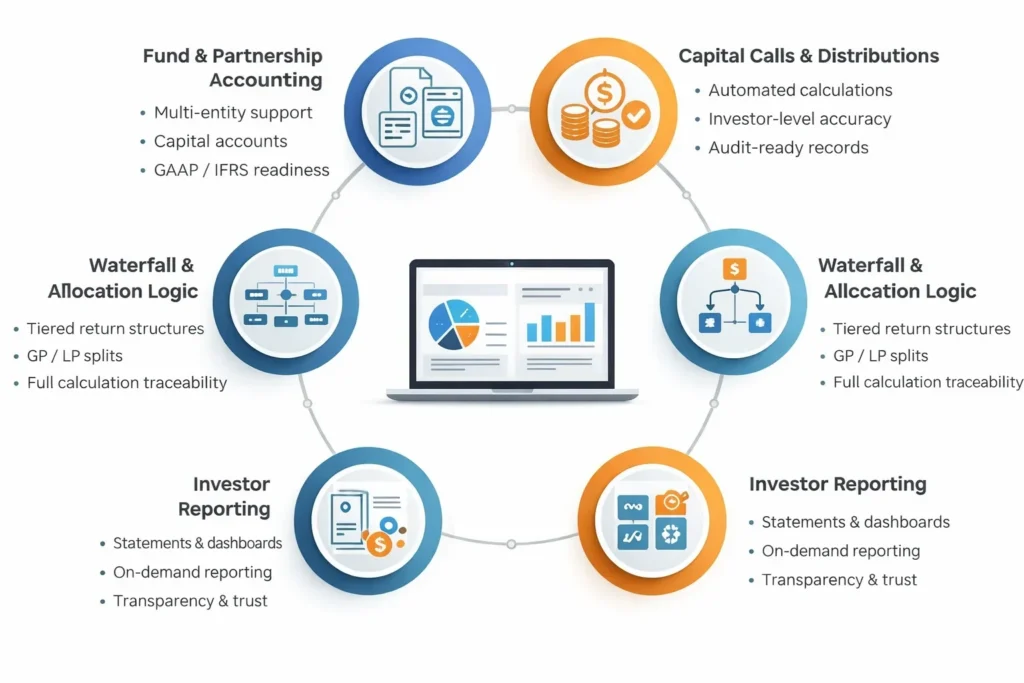
For many private equity firms, particularly those managing multiple funds and complex investor structures, the back office delivers the greatest value. According to Gartner, more than 80% of large-company CFOs are currently undertaking or planning significant digital finance transformation projects, including automation, cloud ERP, and AI-enabled tools, reflecting a broad shift away from legacy and spreadsheet-driven finance operations. Back-office platforms reduce dependence on spreadsheets, minimize manual reconciliation, and automate repetitive tasks such as capital call processing and distribution calculations.
One of the most important functions is the waterfall calculation. Waterfalls define how returns are allocated between limited partners and general partners across various performance thresholds. When these calculations are embedded in opaque systems or handled manually, firms may struggle to explain results to auditors or investors. Transparent and flexible back-office software allows firms to trace every calculation step, ensuring confidence, clarity, and accountability.
Comparing Market Solutions
The private equity software market offers a wide range of solutions, each with distinct strengths. Some platforms specialize in accounting precision, while others aim to cover front-to-back workflows.
FundCount is positioned as a back-office-centric solution that combines fund accounting, partnership accounting, allocations, and reporting in a single system. Its focus on transparency and traceability makes it particularly suitable for firms that require detailed insight into financial calculations and investor reporting.
Also Read: Investment Trends and Market Insights for 2026
Other platforms, such as FIS Private Capital Suite, SS&C Advent Geneva, Allvue Systems, eFront, MSCI Private i, and Yardi Investment Suite, address different needs, from global multi-currency accounting to analytics, real estate specialization, and integrated front-office functionality. The key is not identifying the “best” platform overall, but the one that aligns most closely with the firm’s operational priorities.
Front Office vs. Back Office: Tailor to Your Firm
Every private equity firm has a unique operating model. Firms that focus heavily on deal sourcing and fundraising may benefit from strong front-office tools, while those managing complex funds and reporting obligations often gain more value from robust back-office systems.
Paying for features that are rarely used adds unnecessary cost and complexity. For example, a family office with limited deal-flow requirements may find little benefit in advanced CRM tools. At the same time, a multi-fund manager may prioritize automation, accuracy, and depth of reporting. Matching software capabilities to actual workflows ensures better adoption and long-term efficiency.
Critical Considerations Beyond Core Features
Beyond functionality, several practical factors should influence the final software decision. Integration capabilities are essential, as the system should work seamlessly with existing tools and data sources. Poor integration often leads to duplicated data entry and inconsistent reporting.
Scalability is another critical factor. As assets under management grow, the software must support increased volume without performance issues. Ease of use also matters, as intuitive interfaces reduce training time and improve adoption across teams. Finally, security and compliance features are non-negotiable, given the sensitive nature of investor and financial data.
Sandbox Trials: Don’t Buy Blindly
Before committing to any private equity software, firms should take advantage of sandbox or trial environments. These allow teams to test real-world scenarios, evaluate reporting outputs, and confirm that the system effectively handles complex workflows. Testing the software with realistic data helps identify limitations early and reduces the risk of costly implementation challenges later.
Conclusion
Selecting private equity software requires a clear understanding of what the firm truly needs and what it can do without. By focusing on operational priorities, evaluating both front- and back-office requirements, and testing systems thoroughly before purchase, firms can choose a solution that enhances accuracy, efficiency, and investor confidence. A well-aligned software platform is not just a tool, but a long-term foundation for sustainable growth in an increasingly complex private equity landscape.