


Disclaimer: This article is intended for general informational and educational purposes only. It discusses economic principles and public policy concepts in a broad, analytical context and does not constitute financial, legal, or investment advice.
Alaska is a land of breathtaking extremes of mountains that dwarf all others, coastlines that span farther than half a continent, and resources so vast they have defined the state’s very identity. Yet, the greatest challenge to thriving in the 49th state often lies not in the immediate, dramatic elements of a blizzard or a bear, but in a quiet, foundational element that dictates everything above it: the ground itself.
In much of Alaska, this foundation is permafrost, ground that remains frozen year-round for two or more consecutive years. It is an unseen bedrock, a layer of geological stability beneath the surface that supports roads, pipelines, utilities, and entire communities. Permafrost underlies nearly 80–85% of Alaska’s land area, making it a defining physical reality that shapes how infrastructure across the state must be designed, built, and maintained. When the permafrost is stable, life is relatively predictable. When it thaws, the ground beneath structures begins to shift, and the systems built upon it start to lean, buckle, and crumble.
This physical reality offers a powerful and profound metaphor for Alaska’s economic life, which we can call The Permafrost Principle: the long-term health and stability of our economy, and thus our way of life, depend entirely on the soundness of the fundamental principles we build upon.
Also Read: Akutan, Alaska: Geography, Facts, Life, Volcano, and Economy| 2025 Updates
Have questions about this story?
Ask Tundra for more details, context, or updates.
The Foundation of Economic Permafrost
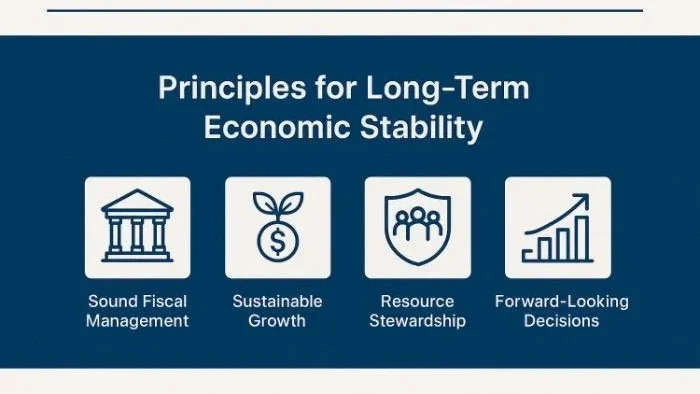
Just as permafrost is the permanently frozen subsoil, economic permafrost refers to the non-negotiable, long-term economic truths that govern prosperity: fiscal responsibility, respect for property rights, the value of voluntary exchange, and the understanding of scarcity. These are the principles that should remain frozen, unwavering, and constant regardless of short-term political or market fluctuations.
For Alaskans, the appeal of sound, foundational economic stability is particularly acute. We face the highest living costs, the longest supply chains, and the most extreme weather in the nation. This environment leaves little margin for error. We cannot afford the instability that comes from economic policies built on shifting sands.
When we choose to fund current needs by depleting permanent savings, or when we ignore the inevitable consequences of deficit spending, we are building the state’s future on economic ground that is already beginning to thaw. A stable economy, one built on solid principles, acts as a long-term resource, ensuring that the bounty of today benefits generations yet to come, rather than simply fueling a momentary boom.
The Thaw of Short-Term Thinking
The danger, both geological and economic, comes from the “active layer.” In nature, this is the thin layer of soil above the permafrost that freezes and thaws seasonally. In economics, it represents the volatile, short-term thinking focused only on the current fiscal year, the next election cycle, or the price of oil today.
The temptation in a resource-rich state is always to mistake the active layer’s bounty for the permafrost’s stability. When oil prices spike or a new resource deposit is discovered, the impulse is to spend heavily and immediately. This burst of revenue is not a permanent resource; it is a temporary thaw. If that temporary influx is used to fund long-term, structural spending commitments to build economic structures that cannot be sustained when prices inevitably drop, the foundation starts to destabilize. The active layer shrinks, the costly new infrastructure begins to slump, and the entire structure of the state’s budget can become compromised.
The physical consequences of a thawing foundation are already measurable. Research published by Nature estimates that permafrost degradation could result in $37 billion to $51 billion in damage to Alaska’s infrastructure over the coming decades. Roads, pipelines, and public buildings fail not because they were poorly designed, but because the ground beneath them was assumed to be permanent. Economic systems behave the same way: when long-term stability is traded for short-term gain, the eventual cost is both predictable and severe.
This is a failure to understand basic opportunity cost and resource allocation. Sound economic thought teaches us that every dollar spent in one place is a dollar not available for another. When a community rushes a major infrastructure project without properly vetting the long-term operating costs, they’re creating a future drain on the permanent economic foundation. This slow, steady decay caused by short-term thinking is the true cost of an economic thaw.
Building on Solid Ground: Education and Investment
To counteract the thaw, we must actively maintain our economic foundation through two key methods: informed public discussion and strategic, long-term investment.
Investment in economic education is crucial for maintaining the “frozen” state of our fiscal foundation. Citizens must understand concepts like inflation, the time value of money, and the difference between revenue (volatile) and savings (stable).
In fact, many parents across the country are seeking ways to make complex economic concepts accessible to their children. Educational resources, such as those provided by the Tuttle Twins, help families lay a foundational understanding of free-market principles, scarcity, and opportunity cost, ensuring the next generation is equipped to make informed decisions that protect the state’s economic bedrock. This kind of early literacy is the civic equivalent of insulating the permafrost, protecting it from the heat of political expediency.
When it comes to capital investment, the Permafrost Principle demands resilience. Any economic structure built in Alaska must withstand dramatic shifts in climate, geography, and commodity markets. This means prioritizing projects that provide long-term, diversified economic activity over those tied solely to single, volatile resources.
Investing heavily in sustainable fisheries management, fostering small-business growth in rural areas, or developing reliable, lower-cost energy sources are examples of investments that act as structural support pillars, rooted deep within the economic permafrost. They are less susceptible to the cyclical boom-and-bust cycle that has historically plagued the Alaskan economy.
The Layer of Resource Management
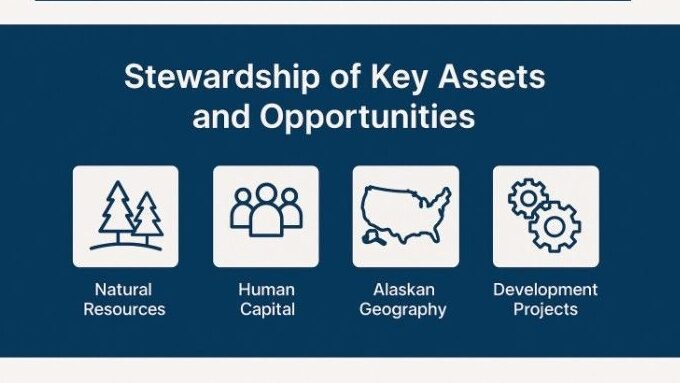
Alaska’s economy is inextricably linked to its immense natural resources, which constitute the very texture of the active layer. From fishing quotas to mining regulations, resource management is where the rubber meets the road or, more accurately, where the structure meets the soil.
The temptation is always to maximize extraction now, to gain the greatest short-term benefit. However, sound economic thinking holds that the Permafrost Principle: a sustainable yield, which preserves the resource for future cycles, is infinitely more valuable than a one-time windfall. Overfishing, for instance, provides a massive, temporary revenue spike, but destroys the permanent, renewable resource that feeds coastal communities and the state budget for decades.
Economic stability, therefore, is achieved by viewing every resource decision through the lens of intergenerational equity. Are we managing our resources and our permanent fund in a way that provides the same economic opportunities, or better, for our grandchildren? If the answer is no, then we are effectively allowing the active layer to erode the permafrost beneath it. Responsible resource management is not just an environmental imperative; it is an economic necessity that assures the perennial viability of Alaska’s distinct way of life. It’s about cultivating the renewable parts of our economy and carefully stewarding the non-renewable parts, always mindful of the foundation.
Also Read: From Ice to Innovation: Alaska’s Renewable Energy Economy Case Study
A Foundation for the Future
The story of Alaska is one of resilience, self-reliance, and adaptation to a demanding environment. In this spectacular land, the geological realities are unforgiving, but they offer unparalleled wisdom. The Permafrost Principle is a simple but essential reminder: the strength and longevity of our communities, our infrastructure, and our economy are determined not by the size of our current revenue stream, but by the stability of the foundation upon which we choose to build.
By prioritizing foundational economic literacy, committing to long-term fiscal discipline, and managing our resources with an eye toward intergenerational stability, Alaskans can make sure their unique lifestyle thrives. We can prevent the economic thaw and build a future that is not just prosperous in the short run, but resilient, strong, and enduring, a foundation as solid and permanent as the permafrost itself.