




In 2025, the value of a military base is measured less by how many troops it hosts and more by where it is located, what missions it supports, and how quickly it can influence events. Strategic military bases shape global security by enabling missile warning, nuclear deterrence, rapid air and naval deployment, and sustained overseas presence.
According to publicly available defense and research data, there are 750+ overseas military bases worldwide, with the United States operating the largest global network, followed by the United Kingdom, France, Russia, and China. These military facilities form the backbone of modern defense strategy, often determining outcomes before a conflict escalates.
Have questions about this story?
Ask Tundra for more details, context, or updates.
What Makes a Military Base Strategic?
A base is generally considered strategic when it meets several measurable criteria. Location is the first factor. Bases near maritime chokepoints, missile flight paths, or contested regions provide outsized influence. Capability is equally important: strategic bases support missile defense, early warning, power projection, or command-and-control, rather than routine training alone.
From a numerical standpoint, analysts often look at:
- Response time (how quickly forces can deploy)
- Sustainment capacity (fuel, runways, ports, storage)
- Mission uniqueness (missile defense, nuclear command, space surveillance)
- Alliance integration (multinational command roles)
Global Military Footprint in Numbers (Context)
| Metric (2024–2025) | Verified Figure |
| Global military spending | $2.72 trillion |
| U.S. defense budget | $997 billion |
| Share of global spending (U.S.) | ~37% |
| Countries with overseas bases | 30+ |
| U.S. “persistent” overseas bases (CRS definition) | 68 |
| Additional U.S. overseas sites | 60 |
These figures explain why discussions about strategic military bases globally are closely tied to defense budgets and long-term posture planning.
Also Read: The Arms Race 2025: Who’s Spending the Most on Weapons and Why It Matters
Strategic Military Bases Globally: Regional Breakdown
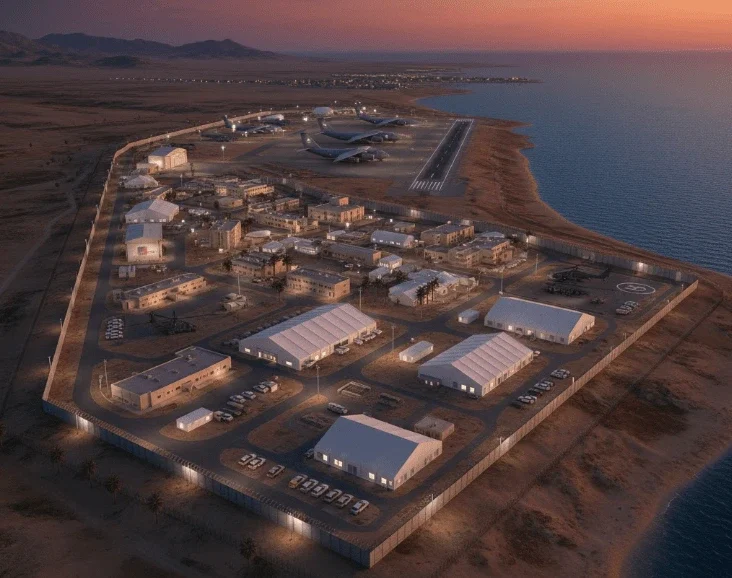
North America and the Arctic (Missile Defense & Early Warning)
Fort Greely
Fort Greely is the centerpiece of U.S. homeland missile defense. It hosts the majority of the nation’s operational Ground-Based Midcourse Defense interceptors, designed to stop limited intercontinental ballistic missile attacks. Its Arctic location aligns with the shortest missile trajectories from Asia, making it one of the most advanced military bases in the world from a defensive technology standpoint.
Clear Space Force Station
Clear Space Force Station supports ballistic missile early warning and space surveillance. Systems at Clear reduce detection time to seconds, feeding directly into national command networks. Its role is preventive rather than operational, which is why it remains strategically critical despite a relatively small footprint.
Europe (Alliance Logistics & Reinforcement)
Ramstein Air Base
Ramstein is one of the most powerful military bases in Europe. It serves as a logistics and air mobility hub for U.S. and NATO forces and hosts the headquarters of U.S. Air Forces in Europe–Africa. Thousands of flights move through Ramstein each year, enabling rapid reinforcement across Europe, Africa, and the Middle East.
RAF Fylingdales
RAF Fylingdales operates a ballistic missile early-warning radar. While it does not host combat aircraft, its radar coverage supports nuclear deterrence and contributes to alliance decision-making timelines.
Also Read: How Drones Are Changing Modern Warfare Forever (2025 Explained)
Indo-Pacific (Naval Dominance & Deterrence)
Kadena Air Base
Often described as the hub of airpower in the Pacific, Kadena supports nearly 18,000 U.S. personnel and 4,000+ Japanese employees and contractors. Its annual economic footprint exceeds $700 million, reflecting permanent operational capacity rather than temporary access. Kadena enables rapid air response across East Asia.
Yokosuka Naval Base
Yokosuka hosts forward-deployed naval forces, including aircraft carrier strike groups. Its location allows a persistent maritime presence in the Western Pacific without reliance on rotational deployments from the continental United States.
Andersen Air Force Base
Andersen Air Force Base supports long-range bomber operations. Because Guam is U.S. territory, it provides strategic depth and legal certainty for sustained operations in the Indo-Pacific.
Yulin Naval Base
Yulin supports China’s ballistic missile submarine fleet. From a strategic perspective, its underground infrastructure enhances second-strike survivability, a key factor in nuclear deterrence calculations.
Middle East (Air Power & Maritime Security)
Al Udeid Air Base
Al Udeid hosts forward command elements and supports air operations across West Asia. It has played a central role in coalition operations for over two decades, making it one of the most strategic overseas military bases in the region.
Naval Support Activity Bahrain
Naval Support Activity Bahrain underpins maritime security in the Persian Gulf and Strait of Hormuz, through which about one-fifth of global oil trade passes.
Russia and Eurasia (Nuclear Deterrence)
Murmansk Naval Base
Murmansk supports Russia’s Northern Fleet, including nuclear-armed submarines. Its ice-free access to the North Atlantic allows year-round operations, a rare advantage at this latitude.
Africa (Chokepoint Access)
Camp Lemonnier
Camp Lemonnier is the primary permanent U.S. base in Africa. It sits near the Bab el-Mandeb Strait, through which around 10% of global maritime trade passes, linking the Red Sea to the Indian Ocean.
Also Read: Nuclear Weapons: Which Countries Have Them and Why? (2025 Overview)
Overseas Military Bases: Who Has the Greatest Reach?
| Country | Estimated Overseas Bases | Strategic Focus |
| United States | 750+ | Global power projection |
| United Kingdom | 140+ | Maritime security |
| France | 120+ | Africa & Indo-Pacific |
| Russia | 20–30 | Arctic & regional |
| China | 5–10 | Expanding logistics |
The scale difference explains why the U.S. remains unmatched in global reach, even as other powers expand selectively.
Most Advanced Military Base in the World (Contextual View)
There is no single “winner,” but bases tied to missile defense and space surveillance are the most technologically complex. Facilities such as Fort Greely and Pituffik Space Base integrate ground-based interceptors, radar, and satellite systems into unified defense networks.
Most Secret Military Base in the US
Area 51
Area 51 is associated with advanced aerospace research, confirmed through declassified historical records. Its strategic importance lies in research and development, not force deployment.
U.S. Military Boot Camps (Force Generation Infrastructure)
| Base | Branch | Function |
| Naval Station Great Lakes | Navy | Only enlisted boot camp |
| Lackland Air Force Base | Air Force | Basic military training |
| Marine Corps Recruit Depot Parris Island | Marines | Recruit training |
| Fort Moore | Army | Infantry training |
Training facilities do not project power directly, but they sustain every overseas military base operationally.
Also Read: Top 10 Most Powerful Militaries in the World
Conclusion
The most strategic military bases in 2025 are defined by mission relevance, geographic positioning, and technological integration, not size alone. Missile defense hubs, naval strongholds, and logistics centers now shape global security more than traditional garrisons. As defense budgets rise and global tensions persist, these military facilities will continue to determine how nations deter conflict and manage crises.
FAQs
1. Which country has the most strategic military bases in the world?
The United States has the most strategic military bases, with hundreds of overseas facilities supporting global operations, deterrence, and logistics.
2. What is considered the most powerful military base in the world?
There is no single most powerful base, but large command-and-control hubs like Ramstein Air Base and major naval hubs like Yokosuka are among the most influential.
3. What is the most advanced military base in the world?
Missile defense and space-warning bases, such as Fort Greely in Alaska, are considered the most technologically advanced due to their integration with global detection systems.
4. Why does the United States maintain so many overseas military bases?
Overseas bases allow faster response to crises, support alliances, protect trade routes, and strengthen deterrence without deploying forces from the U.S. mainland.
5. Which military base is the most secret in the United States?
Area 51 in Nevada is widely regarded as the most secret U.S. military base, primarily used for classified aerospace research and testing.
6. Are overseas military bases increasing or decreasing globally?
Overall numbers are relatively stable, but strategic expansion is occurring in regions like the Indo-Pacific and the Arctic due to rising geopolitical tensions.
7. Do military bases increase the risk of global conflict?
Military bases can deter conflict by signaling strength, but they may also raise tensions when located near disputed regions or rival powers.