





Disclaimer: This information is provided for general educational purposes and does not substitute for jurisdiction-specific legal advice.
Deadlocks in property ownership arise when co-owners disagree. Lack of concern with such stalemates tends to complicate financial and legal implications. Delays add up to higher expenses, strain, and long-term harm. Learning about consequences promotes timely and responsible behavior.
Property ownership deadlocks most commonly occur in situations involving inherited properties, jointly purchased investment real estate, or post-divorce ownership arrangements. While disagreements may initially seem manageable, unresolved deadlocks can escalate into serious legal and financial consequences depending on jurisdiction-specific property laws and court procedures.
This pattern is not limited to individual ownership disputes. Empirical research on property disputes in multi-owned buildings shows that shared ownership structures with unclear decision-making authority are significantly more likely to experience persistent conflicts that escalate into formal legal proceedings. Tribunal case data from such studies indicates that when multiple parties must agree on the use, maintenance, or sale of a property, delays and stalemates become more frequent, increasing both financial costs and legal complexity over time. These findings reinforce the importance of early resolution mechanisms in any form of shared property ownership.
Have questions about this story?Ask Tundra for more details, context, or updates.
The Consequences of Unresolved Property Disputes
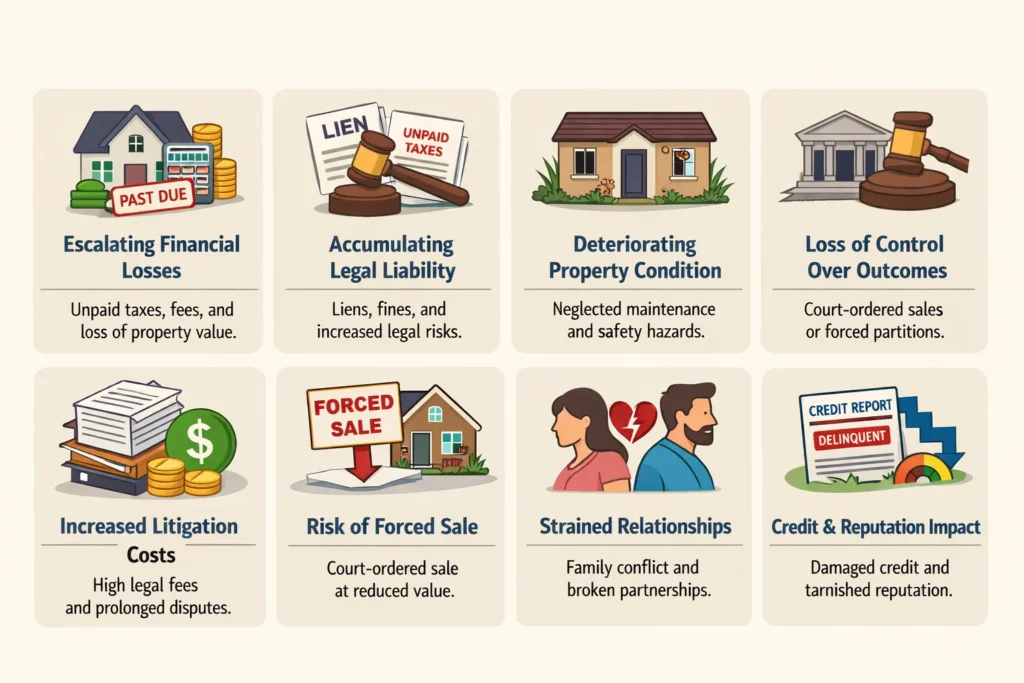
Escalating Financial Losses
There is no selling, refinancing, or productive use of property that is in a deadlock. Costs are growing in the absence of everyday decisions. In many cases, taxes, insurance, utilities, and maintenance expenses remain unpaid.
All owners suffer the burden of heightened financial pressure. When co-owners cannot agree on maintenance, leasing, or sale decisions, properties are often left unused or poorly maintained, which directly reduces market value over time. Neglecting problems can cause economic damage to escalate rapidly. This situation is common in inherited properties where one owner wants to sell while the other refuses, leaving the expenses unpaid.
Accumulating Legal Liability
The inaction can expose the company to legal liability. Liens or unpaid taxes attract remedial measures. Local fines can result from the property’s poor condition. Liability is also enhanced in cases where the responsibilities are not specified. Later, this may be perceived by the courts as inaction. The risks associated with legal issues increase as deadlocks continue. In practice, courts may view prolonged inaction as neglect, increasing exposure to enforcement actions or third-party claims.
Deteriorating Property Condition
Abandoned properties are physically worn out. Maintenance disputes delay required repairs. Damage decreases the marketability and resale value. Hazards associated with safety can arise without any warning. Responsibility for losses is shared. Neglecting maintenance responsibilities often leads to disputes over fault and cost-sharing, further accelerating financial and legal conflict between co-owners.
Also Read: How Proper Land Maintenance Can Boost Your Property’s Resale Value
Loss of Control Over Outcomes
The failure to account for deadlocks often leads to compulsory judicial intervention. In many jurisdictions, courts may resolve ownership deadlocks through partition actions, court-ordered sales, or the appointment of trustees, often without accommodating individual owner preferences. Under the partition law, courts have broad authority to divide property, order a sale, and adjust the final proceeds based on each owner’s documented financial contributions when co-owners cannot agree, thereby significantly altering expected outcomes.
Courts reach final decisions irrespective of preferences. Owners lose control over the timing and terms of key decisions. Court-imposed outcomes may differ significantly from what the owners originally intended. Timely intervention maintains decision-making power. Delay effectively places final decision-making authority in the court’s hands.
Increased Litigation Costs
When conflicts persist over the long term, the costs of law are high. The fact becomes difficult to collect precisely. As disputes drag on, delayed evidence collection and prolonged proceedings further increase legal expenses for all parties involved. Expenses decrease ultimate economic recuperation. Unnecessary legal spending is minimized through early resolution.
Strained Personal Relationships
Stalemates destroy families, friendships, or businesses. During prolonged inaction, resentment develops. The communication failure turns out to be irreversible. Stress influences the psyche emotionally. Lawsuits make enmity even more aggressive. Since neglecting issues is unnecessary, neglecting relationships is superfluous as well.
Legal Enforcement Actions
Governmental agencies can be strict enforcers of compliance. Penalties, fines, or foreclosures might follow. Enforcement increases due to owners’ lack of cooperation. The will of the law prevails over individual will. Under the court’s supervision, compliance becomes compulsory. Deadlock should not be ignored, as it opens up enforcement.
Risk of Forced Sale
The courts can order the sale of property. Owners get proceeds after deductions. Sales can be forced at a lower price. It is a disadvantage for everyone due to timing. Owners miss strategic selling. A forced sale is more likely if the deadlock issue is ignored. Forced sales often occur when co-owners remain deadlocked for extended periods, particularly in family-owned or jointly held properties.
Unequal Financial Adjustments
Unpaid contributions are used to alter proceeds by courts. One of the owners can lose anticipated compensation. Final distributions are based on financial records. Lack of documentation does not help in recovery. The effect of delay is that it makes accounting inaccurate. Ineffective management of problems undermines finances. Courts often rely on financial records, payment histories, and documented contributions to determine final adjustments, which can disadvantage owners who failed to maintain proper records.
Credit and Reputation Impact
Credit profiles are subject to unpaid obligations. Cases in the court law generate records. Damage to reputation has future investing impacts. Unresolved disagreements are considered harmful to lenders. There could be a long-term loss of professional credibility. There are long-lasting effects of overlooking deadlocks.
Missed Alternative Resolution Opportunities
Mediation usually resolves disputes in a friendly, early-stage manner. Delays minimize willingness to compromise. With conflict continuing, trust is destroyed. Alternative solutions lose their effectiveness. Attempts at resolution are preferred in courts. Excluding options limits flexibility.
Significance of Attorney Advice
There are risks that are explained coherently by a San Diego property partition attorney. Lawyers present alternatives and repercussions at an early stage. The legal advice eliminates procedural errors. Advice from the professionals helps to reorganize the situation and get the move going. The early intervention safeguards finances and rights.
Conclusion
Ignoring property ownership deadlocks carries severe legal consequences. Financial losses, litigation, and forced outcomes often follow. Emotional and relational damage escalates with delay. Early resolution preserves control and value. Legal guidance supports informed and timely decisions. Awareness prevents costly and lasting mistakes. Addressing ownership deadlocks early, even through informal mediation or structured negotiation, often preserves property value and decision-making control.
Also Read: How to Increase Property Value with Innovative Strategies