





Disclaimer: This article is for informational purposes only and does not constitute financial, investment, or legal advice. Market conditions can change rapidly, and readers should conduct their own research or consult a qualified professional before making any investment decisions.
As 2025 draws to a close, you’re likely asking where investment opportunities lie and what risks demand your attention. The return on deployed capital is under pressure, yet corporate and investor appetite remains high. For instance, business owners in the Netherlands expect net investment to increase in 2026, despite profitability declining in Q3 2025. At the same time, major market-outlook reports from J.P. Morgan and others point to AI, inflation, and rate trajectories as defining themes. In this article, you will find: three key questions investors should ask heading into 2026; major thematic predictions influencing asset classes; and how you can position your portfolio or deal strategy accordingly. Understanding these signals matters because complacency in today’s market can be costly.
Have questions about this story?
Ask Tundra for more details, context, or updates.
3 Critical Questions for Investors Heading Into 2026
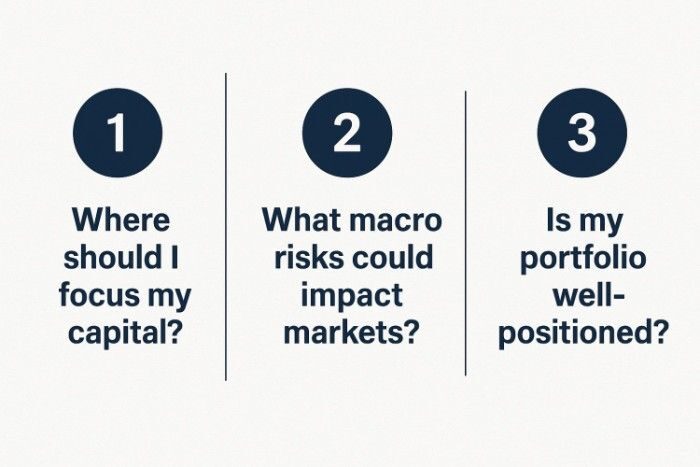
According to a recent Seeking Alpha article, three fundamental questions dominate investor thinking: Where will profit growth come from? Can valuations be justified? And how will policy and macro pressures play out?
First, profit growth is under scrutiny: many companies face margin compression, supply-chain risks, and elevated input costs. Second, on valuation, stretched multiples mean investors demand more than “hope”; they demand visible drivers of returns. Third, macro and policy risks remain elevated: inflation, central bank pivots, and geopolitical tensions all weigh on the investment environment. Unless you can clearly answer these questions, deploying capital into 2026 without a strong thesis may risk misalignment.
Profit Growth: Where Will It Come From?
Profit expansion is no longer automatic. In regions like the Netherlands, companies expect to increase investment in 2026, even though profitability in Q3 2025 has already declined. This suggests firms see opportunities, but you’ll want to track whether those investments translate into higher returns or just higher cost bases. Here, structured reporting often consolidated through an investment data room helps investors assess whether companies have realistic paths to margin expansion.
Valuations and Policy: Are They Aligned?
Markets are navigating a junction of stretched equity valuations, technological disruption, and transitioning policy regimes. For example, one piece notes that experts expect volatility in 2026 as inflation, rate shifts, and AI uncertainty interact. What this means for you is that valuations demand clear justification, and a complacent “multiple expansion” rationale may no longer suffice. Moreover, central-bank policy pivots (e.g., rate cuts or hikes) can trigger shifts in sectors, asset classes, and geographies. The takeaway: ensure your investment thesis accommodates both upside catalysts and downside risk from policy mis-execution.
Thematic Forecasts: What Will Drive 2026?
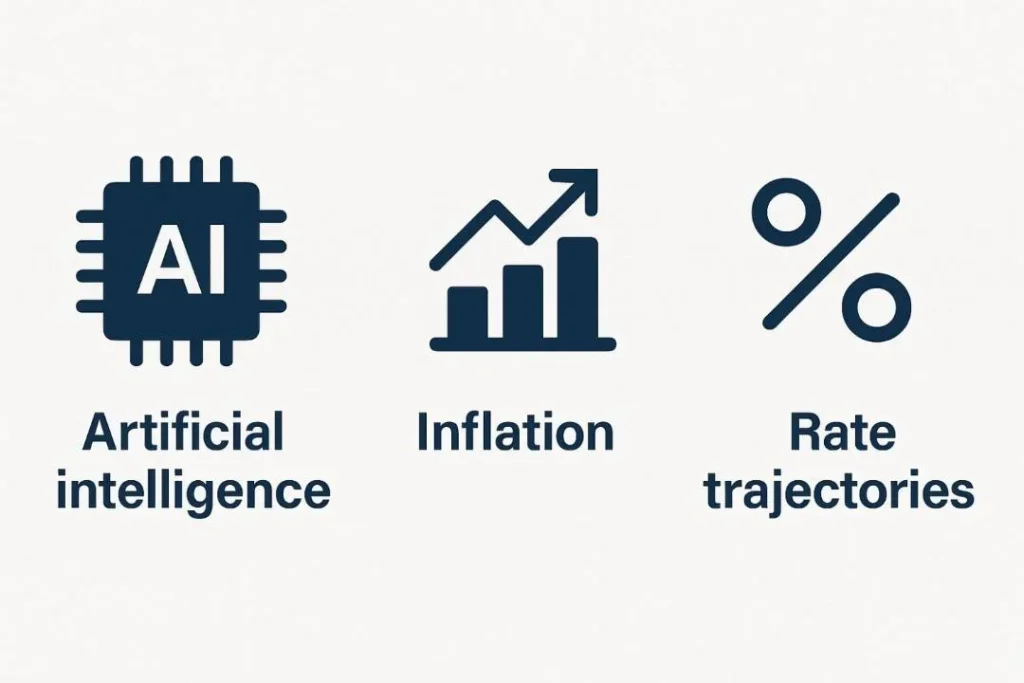
Looking ahead to 2026, several major trends matter. One: Business investment is expected to pick up despite current profitability headwinds. Two: technology, especially AI and related areas, remains a focal point for growth, but also comes with heightened uncertainty. Three: global policy shifts, inflation dynamics, and cross-border capital flows are shaping the backdrop.
Rising Investment Despite Profit Pressure
A surprising but actionable trend is that many firms are signaling increased capital expenditure in 2026, even as profits dip now. In the Netherlands alone, businesses outside finance expect a net +3.6 % increase in investment next year, despite negative business confidence. For you, this signals an inflection point: if companies invest now, your investment or M&A thesis should assess whether that CAPEX leads to higher productivity or simply higher overhead.
Technology & AI: High Reward but High Risk
The technology sector remains front and centre. For example, J.P. Morgan’s long-term capital market assumptions (October 2025) emphasise multi-decade themes such as AI, digitisation, and ecosystem shifts. Meanwhile, other commentary signals that as the hype cycle around generative AI matures, enterprises may defer portions of planned AI spending. For your strategy, this duality matters: you must differentiate between firms with a structural advantage versus those chasing the trend.
Policy, Rates, and Global Capital Flows
Analysts expect policy decisions and cross-border capital flows to be major catalysts in 2026. Rate adjustments, trade policy changes, and inflation pacing could rapidly reshape sector leadership. This makes scenario-based planning essential and increases reliance on structured data environments, such as an investor data room, to evaluate risk consistently across geographies.
Also Read: The Role of Financial Leaders in Business Growth
How to Position for 2026
Investors and deal professionals can prepare by focusing on clarity, discipline, and scenario modelling. Prioritise businesses with credible efficiency improvements or defensible growth paths. Consider themes where investment momentum is rising, such as infrastructure upgrades, digital transformation, and operational automation. Build flexibility into your thesis and ensure your decision-making is grounded in high-quality, verifiable documentation.
Here, leveraging an investor data room provides an added advantage: it centralises financials, ESG reports, forecasts, and risk data into a unified environment that supports faster, more confident review cycles. When markets become more complex, clarity becomes a competitive differentiator.
Also Read: Understanding AI Automation: Everything You Need to Know
Conclusion
Heading into 2026, the intersection of investment-surge signals, stretched valuations, and evolving policy creates a complex but navigable landscape.
2026 will not be a straightforward continuation of 2025. It brings together rising investment, margin compression, AI-driven disruption, and policy uncertainty. To navigate it well, investors must rethink how they evaluate companies, interpret macro signals, and structure their diligence practices.
The year ahead offers opportunities, but only for those who combine strategic discipline with reliable information supported by transparent tools like an investor data room that keeps insights accurate, consistent, and ready for decision-making.