




I was reading a report recently about how global tensions in early 2026 have shifted into a “new phase” of conflict. It is a world that feels increasingly fragmented, where the old rules of engagement seem to be gathering dust. We are seeing fewer massive, country-on-country invasions and more “backyard battles” where the real players are hiding in the shadows. This is the world of the proxy war. To be honest, it is a concept that sounds like something out of a Cold War spy novel, but it is actually the primary way that power is being contested in the 2020s.
Have questions about this story?Ask Tundra for more details, context, or updates.
1) Definition of a Proxy War
So, what is a Proxy War exactly? In the simplest terms, it is a military conflict where at least one of the sides is being supported or controlled by an external third party. Think of it as a hierarchy where a major power is “directing the use of force” through a local agent to get a specific outcome. The third party usually provides the money, the weapons, and the strategy, but they do not send their own soldiers into the line of fire. In this scenario, the local fighters are the “proxies” acting on behalf of a bigger sponsor state. It allows a nation to fight for its interests abroad without having to deal with the political fallout of losing its own troops.
2) How Proxy Wars Happen
The way these conflicts unfold is actually pretty clinical. It usually begins when an internal struggle breaks out in a vulnerable country—maybe over a disputed election or a resource like gold. A major power sees an opportunity to either protect its own security or weaken a rival. Instead of declaring war directly, they start “donating assistance”. This sounds harmless, but it quickly evolves into something much more intense. They might provide high-tech drones, real-time intelligence, or even special operations forces that operate just “out of theatre” to disrupt the enemy’s supply lines. The sponsor state stays behind the scenes, pulling the strings and making sure their “agent” on the ground has enough firepower to keep the fighting going. It is essentially a principal-agent relationship where the sponsor tries to control the violence without ever stepping onto the battlefield.
3) Historical Examples
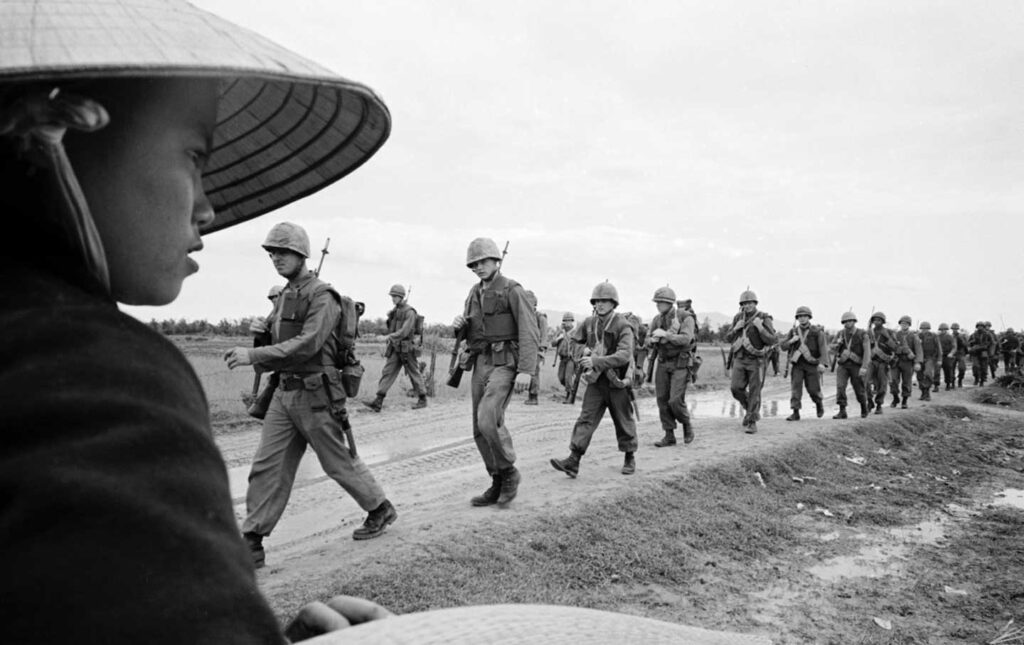
If we look back at the 20th century, we can find some classic Proxy war examples that defined the modern era. The Vietnam War is probably the most famous case of a massive military conflict that was fueled by outside interests. While the United States fought directly on the ground, the communist North was supported by a Soviet-Chinese coalition that poured in weapons and advisors. This support allowed the North to sustain a brutal war of attrition that eventually forced a U.S. withdrawal. Then you have the 1980s Soviet-Afghan conflict. This was essentially the mirror image of Vietnam. The Soviet Union invaded to prop up a failing government, and the United States responded by arming the mujahideen rebels with Stinger missiles. That particular proxy battle became a “quagmire” that crippled the Soviet economy and eventually contributed to the collapse of the USSR.
4) Modern Examples
Fast forward to today, and the landscape has only become more complex. Current proxy wars in the Middle East show us how multiple sponsors can now back different factions within the same country. Take Syria, for instance. For over a decade, it was a spiderweb of interests involving Russia, Iran, Turkey, and the United States all backing different groups. Even after the recent transitions in Damascus, the country remains a site where regional powers like Israel and Turkey face off through local enclaves. Then there is Yemen. It has been described as a regional struggle between Saudi Arabia and Iran, but it has recently turned into a maritime conflict. The Iran-backed Houthi movement has used its role as a proxy to target commercial shipping in the Red Sea, forcing a joint U.S.-Israeli response. These conflicts are no longer simple two-sided fights; they are tangled webs of regional ambition.
5) Impact of Proxy Wars
The real tragedy of this style of fighting is the “state-wrecking” impact it has on the countries where the wars actually happen. Because the sponsors provide a never-ending supply of weapons, there is very little incentive for the local fighters to ever sit down and negotiate. The result is a cycle of violence that destroys the government’s monopoly on power and leaves civilians caught in the crossfire. According to UNHCR’s Global Trends Report, global displacement had already reached a record 123.2 million people in 2024, and the agency’s Global Appeal 2026 projects that figure to climb even further to 136 million by 2026 — a staggering rise that shows no signs of slowing down. In Sudan, which is currently a primary site for proxy competition between Gulf rivals, famine has been confirmed in multiple regions. When the “big powers” outsource their battles, the local population pays the ultimate price in the form of broken infrastructure, collapsed hospitals, and a lost generation of children who know nothing but war.
6) Why They Occur
You might wonder why nations keep doing this if the results are so catastrophic. The answer is purely strategic. First, there is the “cheapest insurance” factor. It is simply more cost-effective to send a crate of missiles than to deploy a division of infantry. Second, in a world with nuclear weapons, proxy battles provide a “safety valve.” It allows superpowers to compete without triggering a global apocalypse. But the biggest reason is plausible deniability. By using a proxy, a state can claim it isn’t “really” involved, which helps them avoid international sanctions or condemnation from the United Nations. At the end of the day, a proxy war is a tool for nations that want to project their power outside their own borders without the messy risks of a formal declaration of war.
The Bottom Line
At the end of the day, we have to recognize that the international system has entered a phase where instability is being used as a strategic instrument. Whether it is in the mountains of Afghanistan or the ports of the Red Sea, the logic of “managing chaos” has become the new normal. For those of us watching from the outside, it is easy to see these as distant geopolitical chess moves. But for the people living through it, a proxy war is not a strategic theory. It is a reality that turns their homes into battlefields for someone else’s interests. As we move further into 2026, the challenge will be restoring some level of accountability to a world that has become far too comfortable with fighting by proxy.