



Disclaimer: This article is for informational and entertainment purposes only. It does not provide financial, legal, or professional advice. Participation in fantasy sports is subject to local laws and personal discretion.
Fantasy sports were once a quiet extension of fandom, played in spreadsheets and email threads by small groups of friends. That version of fantasy leagues no longer exists. As of 2022, there were 50.4 million fantasy sports players in the United States, with fantasy football the most-played sport by a significant margin. Today, fantasy competitions sit at the intersection of sport, community, and digital culture. As the scale and seriousness of these leagues have grown, so has the way victory itself is represented. Traditional symbols like small trophies or cash payouts are increasingly being replaced by more meaningful, visible, and culturally resonant markers of success.
This shift is not accidental. It reflects broader changes in how communities form, how competition is framed, and how participants want their achievements to be seen and remembered.
Have questions about this story?Ask Tundra for more details, context, or updates.
From Informal Wins to Structured Recognition
In the early years of fantasy leagues, winning was largely symbolic. Bragging rights were informal, often limited to a group chat message or an end-of-season email. Rewards, if they existed at all, were usually modest and transactional. Today, however, fantasy football has grown into a mainstream phenomenon: according to Forbes, more than 60 million players in the U.S. and Canada now actively participate, nearly half of whom are young adults deeply integrated into digital and social fan culture.
As leagues became more established, many adopted physical trophies. These borrowed heavily from traditional sports culture, offering a sense of legitimacy and continuity. Over time, however, even trophies began to feel insufficient for leagues that now operate year-round with fixed membership, detailed rule sets, and high engagement.
Fantasy leagues increasingly resemble amateur sporting institutions rather than casual games. With that evolution came a demand for victory symbols that could better represent effort, consistency, and narrative.
The Influence of Sports Entertainment Culture
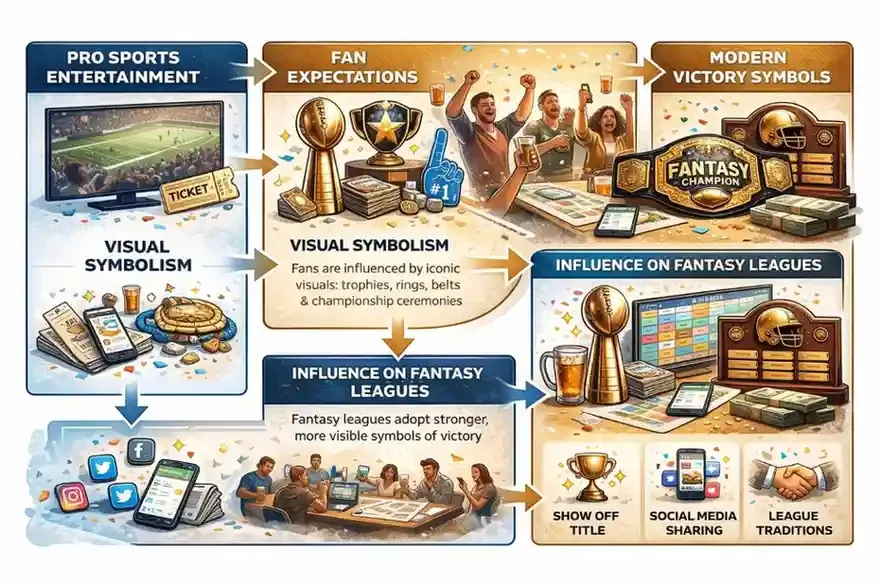
One significant factor driving change is the influence of professional sports entertainment. Fans are more visually and emotionally attuned to symbolism than ever before. Championship ceremonies, title defenses, and iconic images play a central role in how sports are remembered.
Fantasy leagues have absorbed this logic. League members do not just want to win. They want the win to feel significant. This has led to an emphasis on symbols that can be displayed, passed on, and documented across seasons.
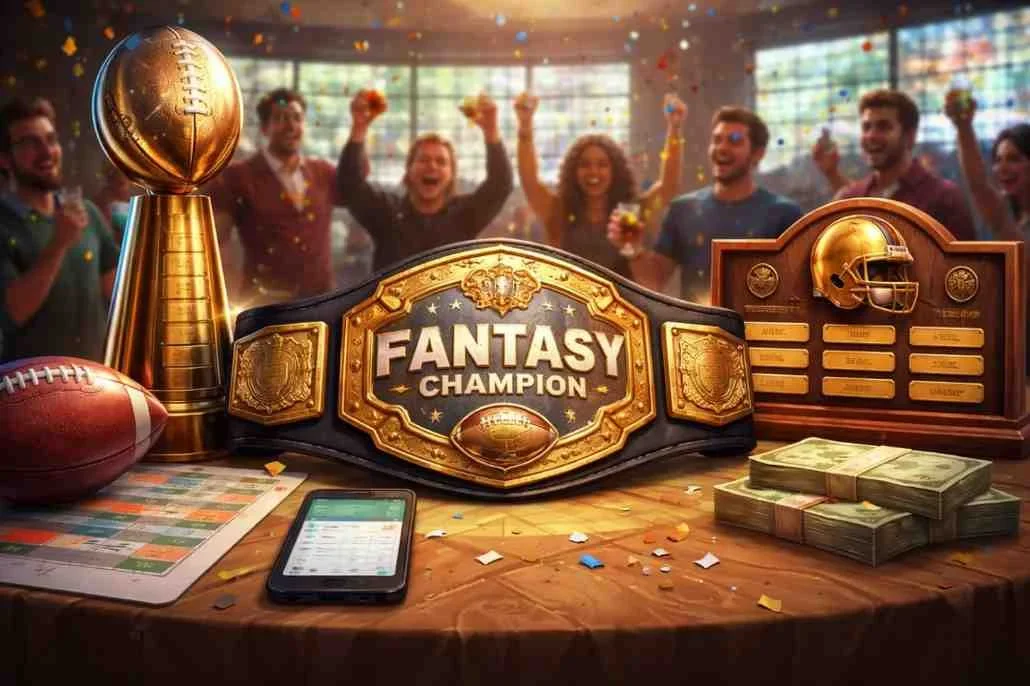
In this context, items such as a custom fantasy football belt have emerged not as novelties but as deliberate attempts to mirror the emotional language of professional competition.
Social Media and the Visibility of Victory
Another key driver is visibility. Fantasy leagues now exist publicly as much as privately. Wins are shared on social platforms, league message boards, and video calls. The victory symbol has become content.
A physical object that can be photographed, worn, or ceremonially presented plays far better in this environment than a line of text or a digital badge. This does not trivialize competition. It amplifies it.
As more leagues share their end-of-season moments online, the expectation of what a championship looks like has changed. Victory is no longer quiet. It is performative, documented, and archived.
Community Identity and Shared Ownership
Modern fantasy leagues often emphasize collective identity over individual gain. Many leagues last for years, sometimes decades. Members age, move cities, and change jobs, but the league remains a constant.
Victory symbols increasingly reflect this shared ownership. Rather than a winner keeping a trophy permanently, leagues opt for items that circulate annually. This reinforces continuity and reinforces the idea that the league itself is the central entity, not just the current champion.
Over time, these leagues become collections of shared moments, with different strands of rivalry, history, friendships, and annual traditions woven together into a single competitive identity.
These circulating symbols also act as historical records. Names, years, and outcomes accumulate, turning the object into a timeline rather than a static prize.
The Decline of Purely Monetary Rewards
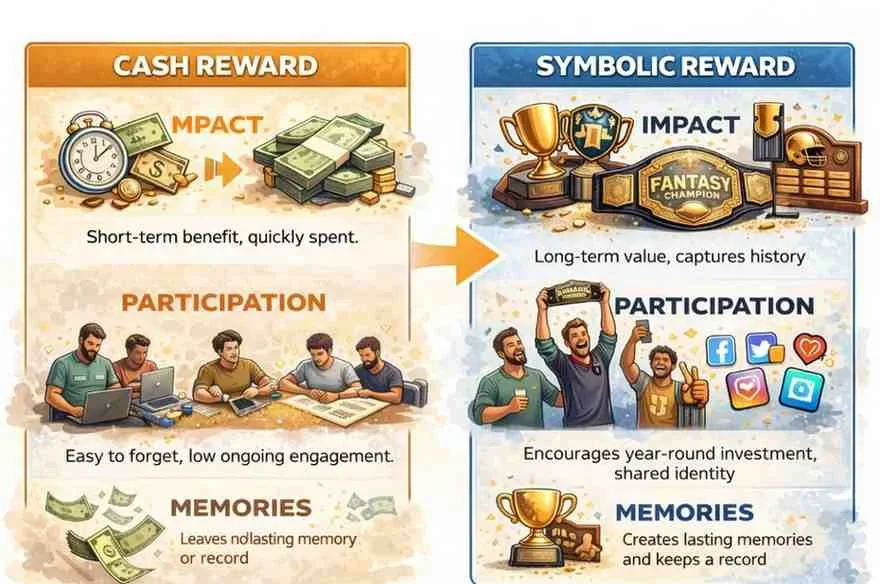
Cash prizes still exist, but they are no longer sufficient on their own for many leagues. Money is easily forgotten. Once spent, it leaves no trace.
Fantasy players increasingly value recognition over reward. The effort invested in managing lineups, tracking injuries, and navigating trades across an entire season demands acknowledgment that feels proportional.
Victory symbols now serve that function. They provide something money cannot: permanence, memory, and narrative weight.
Psychological Stakes and Competitive Integrity
The introduction of more prominent victory symbols has had a noticeable impact on league behavior. When winning comes with a visible, tangible marker, engagement rises across the board.
Managers pay closer attention. Deadlines matter more. Matchups feel heavier. Even those out of contention remain involved because the outcome affects who will hold the symbol of dominance.
This heightened seriousness strengthens competitive integrity. Leagues become less prone to apathy and more resistant to collapse, especially in later seasons.
Customization as Cultural Expression
Another defining trend is customization. Victory symbols are no longer generic. They reflect the league’s personality.
League names, inside jokes, founding dates, and rivalries are increasingly incorporated into design. This turns the symbol into a cultural artifact rather than a store-bought item.
From a journalistic perspective, this mirrors a broader shift in recreational communities. Participants want objects that reflect who they are, not just what they won.
Fantasy Leagues as Micro Institutions
As fantasy leagues grow more structured, they begin to resemble micro institutions. They have governance, rules, penalties, and traditions. Victory symbols are part of that institutional framework.
Just as professional leagues have championships, amateur leagues now establish their own systems of legitimacy. The symbol of victory becomes the most visible representation of that system.
This institutionalization explains why leagues invest time and resources into choosing the right symbol. It is not excess. It is identity formation.
Gender, Inclusion, and Expanding Formats
The reinvention of victory symbols also reflects the expanding diversity of fantasy leagues. Women-led leagues, mixed leagues, dynasty formats, and niche sports leagues all approach recognition differently.
Rather than inheriting symbols from traditional male-dominated sports culture without question, many leagues deliberately redesign what victory looks like to suit their community.
This adaptability is part of why fantasy leagues remain resilient. They evolve not only in gameplay, but in meaning.
Media Coverage and Normalization
As fantasy sports coverage expands in mainstream media, these evolving traditions gain legitimacy. Articles, podcasts, and broadcasts increasingly reference league culture, rituals, and end-of-season ceremonies.
What was once niche behavior is now normalized. Reinvented victory symbols are no longer outliers. They are becoming the expected standard among committed leagues.
From a reporting standpoint, this represents a cultural shift rather than a trend. It is the maturation of fantasy sports into a recognized social activity with its own norms.
Why Reinvented Victory Symbols Are Here to Stay
Fantasy leagues are not just games. They are long-term social structures built around competition, strategy, and shared time. As such, they require symbols that reflect that depth.
Reinvented victory symbols meet that need. They make success visible. They preserve history. They reinforce commitment.
In an era where digital achievements are fleeting, physical symbols regain importance. They ground competition in the real world, giving abstract effort tangible form.
A Reflection of Modern Competition
Ultimately, how fantasy leagues mark victory says as much about society as it does about sport. Participants want recognition that feels earned, shared, and lasting.
The move away from disposable rewards toward meaningful symbols reflects a broader desire for permanence in an increasingly transient digital environment.
Fantasy leagues are not just reinventing how winners are crowned. They are redefining what winning means.