




Ask ten marketers about their B2B lead generation cost, and you’ll probably get ten different answers. Industry benchmarks consistently show that cost per lead varies widely by channel and target audience. For example, Forbes notes that LinkedIn often delivers higher-quality B2B leads despite higher acquisition costs, with some campaigns averaging around $90 per lead compared to $125 on Google Ads, highlighting how channel selection impacts both cost and conversion. Some marketers brag about $30 leads from email campaigns, while others spend hundreds for the same outcome. The reason? Lead generation isn’t one-size-fits-all. Every company’s costs depend on its strategy, industry, and the effectiveness of its systems and personnel.
Let’s break down what actually drives those costs so instead of guessing what’s “average,” you can understand what’s realistic for your business and where your money truly goes.
Have questions about this story?Ask Tundra for more details, context, or updates.
The Anatomy of B2B Lead Generation Costs
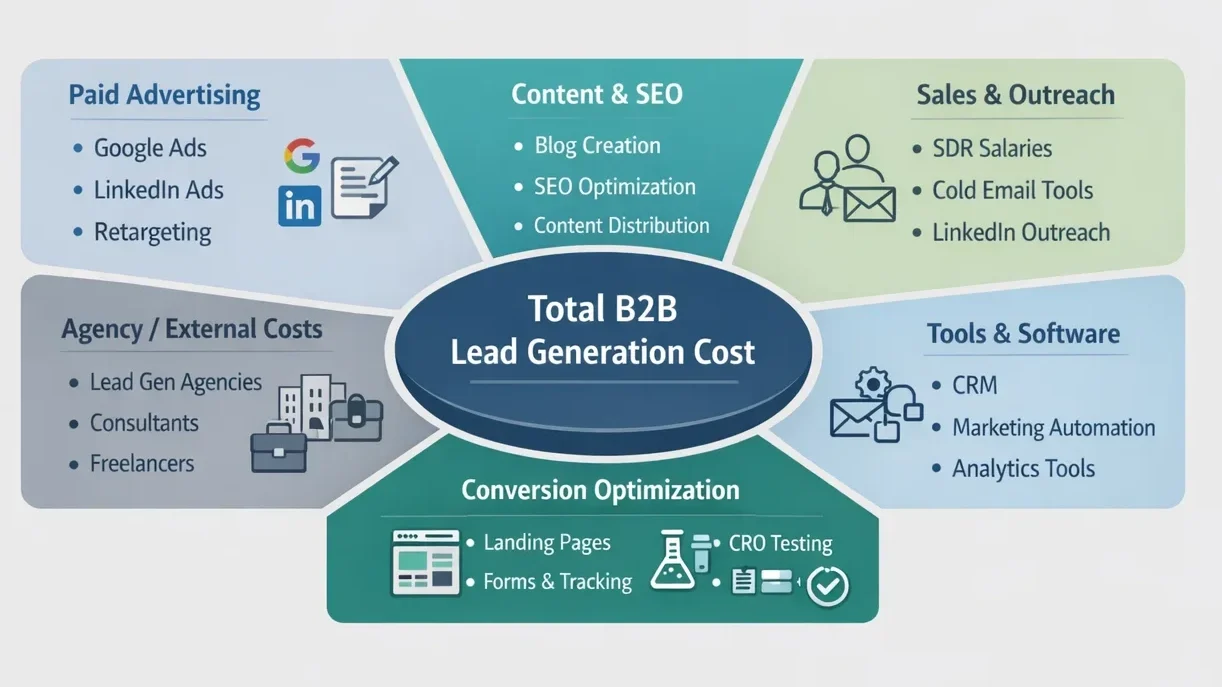
When we talk about lead generation cost, we’re really talking about the sum of several moving parts that make up your total spend. Understanding what’s inside that number helps you see where your budget is leaking.
- Human resources: The biggest expense is often people. SDRs, researchers, data analysts, and managers all contribute to your outbound. A high-performing team can easily account for 40–60% of total lead generation spend.
- Data and tools: CRMs like HubSpot or Salesforce, enrichment tools such as ZoomInfo or Apollo, and automation platforms for outreach or analytics. However, without reliable data and intelligent automation, campaigns often stall before they even begin.
- Channels and content: Every channel comes with its own price tag. Paid ads deliver speed but burn cash quickly, while organic channels (like content marketing or SEO) cost less over time but take patience to scale.
- Lead qualification and conversion: Scoring, nurturing, and handoff processes require both tools and human input. The more refined your qualification system, the higher your upfront cost, but the lower your cost per sales-qualified lead.
A clear view of these cost drivers makes it much easier to understand where efficiency gains are hiding. To see how these factors translate into real-world budgets and transparent pricing models, explore websites like SalesAR.
Factor #1: Industry and Target Market
Your industry plays a massive role in how much you’ll spend per lead. Think of it like fishing: the rarer the catch, the more expensive the bait.
In high-ticket industries, decision cycles are long, the audience is small, and the competition for attention is intense. That drives up acquisition costs. On the other hand, broader markets such as SMB-focused software or marketing services typically see lower CPLs because the audience pool is larger and easier to reach.
On average, lead generation services cost $40 to $800 or more, depending on your sector and target audience. If you’re targeting niche C-level executives at Fortune 500 companies, expect to land on the higher end of that spectrum. However, if your product appeals to a broader audience with faster sales cycles, your costs will be significantly lower.
Factor #2: Lead Quality and Qualification Criteria
There’s always a balancing act between quantity and quality. The stricter your definition of a “qualified lead,” the more it costs to find them, but the better your ROI tends to be.
When your ICP is narrow, and you’re filtering for SQLs only, campaigns require more research, verification, and nurturing. Each lead costs more, but they move through your funnel faster and close at higher rates.
For example, a campaign focused only on decision-makers will naturally be more expensive, since those contacts are harder to reach and often require multi-touch outreach. However, once you connect, those conversations are far more likely to develop into a genuine pipeline.
Factor #3: Data Quality and Source
Your lead generation is only as good as the data behind it. You can have the best messaging and SDRs in the world, but if your contact list is full of outdated or inaccurate info, you’re throwing money away.
Buying cheap bulk lists may seem like a shortcut, but most of those contacts are either irrelevant or no longer active. That leads to low open rates, bounces, and wasted time chasing ghosts. In contrast, verified, intent-based data costs more upfront but pays off in shorter sales cycles and higher conversions.
Factor #4: Outreach Channels Used
The right mix depends on your audience, goals, and available resources.
- Email remains the most cost-effective channel. It’s scalable, personalizable, and delivers excellent ROI when targeting and copy are done right.
- LinkedIn tends to have a higher lead generation price per lead but also stronger engagement, especially for enterprise audiences.
- Cold calling is labor-intensive and can be expensive due to the time and resources required per contact. However, in industries such as logistics, construction, or financial services, it still converts exceptionally well.
- Paid ads on Google or LinkedIn offer instant reach, but their lead-generation costs are typically higher than those of organic outreach or email marketing. They’re great for quick pipeline boosts, but not ideal as your only strategy.
Also Read: How to Write a Marketing Email That Converts in 2025?
A multi-channel approach helps balance the cost of your lead generation services, boosts response rates, and delivers more consistent ROI across channels.
Factor #5: Campaign Scale and Duration
The size and lifespan of your campaign significantly impact your lead generation cost per lead, especially during early testing phases.
A short pilot program often appears expensive because setup requires time and money, list building, messaging tests, automation workflows, and training all consume a significant portion of the early budget.
As a campaign runs longer, performance data starts to work in your favor. You can identify winning subject lines, optimize targeting, and remove underperforming segments. As those insights compound, your cost per lead steadily drops.
Conclusion
The most innovative B2B teams look beyond surface-level CPL and focus on ROI metrics, such as cost per sales-qualified lead and actual pipeline impact. When you track quality and conversion alongside cost, you see the whole picture where your strategy is paying off and where it needs tuning.
Also Read: How to Maximize ROI with Location Incentives Across States