





Critical thinking is widely described as an essential skill, yet it remains poorly trained in practice. People make decisions every day, evaluate claims online, and solve problems at work, but most rely on intuition, habit, or incomplete information rather than structured reasoning.
Research in psychology and education consistently shows that thinking does not automatically improve with experience. Without deliberate practice, people tend to repeat the same reasoning errors.
This is where critical thinking exercises play a decisive role. Exercises transform critical thinking from an abstract concept into a trainable skill. Instead of passively consuming information, learners actively analyze, evaluate, and reflect on how they think.
We are providing a practical, evidence-based guide to critical thinking exercises, including a curated core exercise library grounded in expert research.
Have questions about this story?
Ask Tundra for more details, context, or updates.
Quick Snapshot: Core Critical Thinking Exercises
| # | Exercise Name | What It Improves |
|---|---|---|
| 1 | Assumption Hunt | Identifying hidden beliefs |
| 2 | Claim vs Evidence | Separating facts from opinions |
| 3 | Alternative Explanation | Reducing confirmation bias |
| 4 | Strength of Evidence Check | Evaluating evidence quality |
| 5 | Consequence Mapping | Long-term decision thinking |
| 6 | Question the Question | Better problem framing |
| 7 | What Would Change My Mind? | Open-minded reasoning |
| 8 | Compare Competing Claims | Balanced judgment |
| 9 | Explain It Simply | Clear understanding |
| 10 | Assumption Reversal | Flexible thinking |
| 11 | Evidence Gap Scan | Identifying missing information |
| 12 | Slow Judgment Pause | Reducing impulsive decisions |
| 13 | Trade-Off Listing | Weighing pros and cons |
| 14 | Perspective Shift | Broader viewpoints |
| 15 | Reasoning Audit | Reflective thinking habits |
Why Critical Thinking Matters Today
Modern life places unprecedented demands on judgment. Individuals must navigate information overload, conflicting sources, complex decisions, and rapid change. According to the World Economic Forum, analytical thinking and problem-solving consistently rank among the most important skills for the future workforce.
However, knowing that critical thinking matters is not the same as knowing how to develop it. Reading about logic or bias raises awareness but rarely changes behavior. As educational philosopher Peter Facione noted in the landmark Delphi Report:
“Critical thinking is purposeful, self-regulatory judgment… and it improves most through guided practice and reflection.”
Exercises operationalize this insight. They provide structured opportunities to practice reasoning, identify errors, and refine judgment over time.

What Are Critical Thinking Exercises?
Critical thinking exercises are intentional reasoning practices designed to engage specific cognitive skills such as analysis, evaluation, inference, and self-regulation. Unlike theoretical explanations, exercises require active participation. The learner must slow down, examine evidence, consider alternatives, and justify conclusions.
From a learning-science perspective, exercises work because they introduce what researchers call desirable difficulty. Psychologist Daniel Kahneman, in Thinking, Fast and Slow, explains that human thinking defaults to fast, automatic processes that are efficient but error-prone. Exercises deliberately interrupt this automatic mode and activate slower, more reflective reasoning.
In short, exercises do not aim to produce quick answers. They aim to improve how answers are reached.
Top 15 Critical Thinking Exercises to Improve Reasoning and Judgment
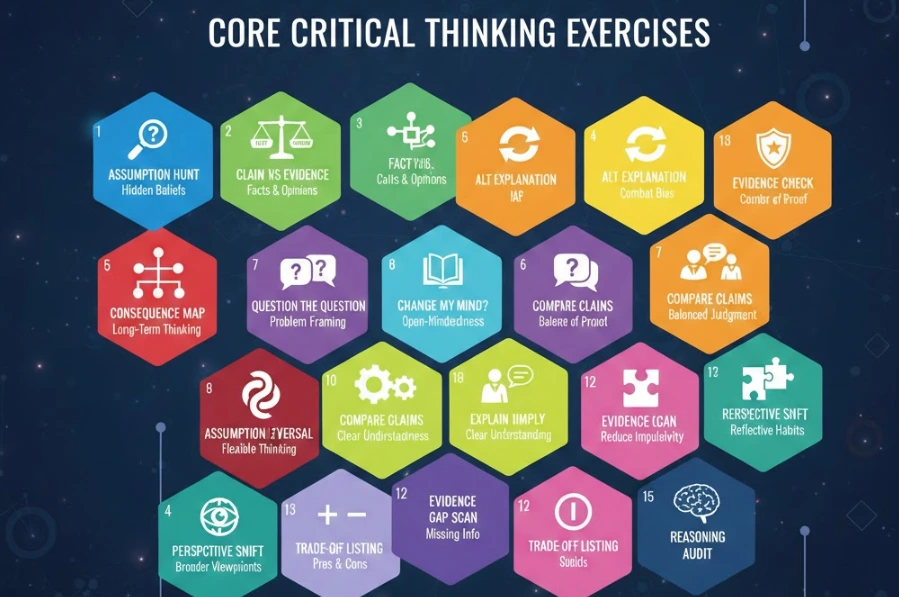
Core critical thinking exercises are structured practices that help improve how people analyze information, evaluate claims, and make decisions. These exercises are not about speed or intelligence. They are about learning to think clearly, fairly, and carefully.
Each exercise below targets a specific thinking weakness that commonly leads to poor judgment, such as hidden assumptions, weak evidence, rushed conclusions, or narrow perspectives. When practiced regularly, these exercises build long-term reasoning habits that apply to everyday life, work, and learning.
1. Assumption Hunt
The Assumption Hunt exercise focuses on identifying ideas that are being accepted as true without proof.
Most arguments, decisions, and beliefs rely on assumptions. These assumptions often go unnoticed, yet they strongly influence conclusions.
How to practice this exercise:
- Start with a claim, opinion, or decision
- Ask what must be true for it to make sense
- Write down every assumption you can identify
- Question whether each assumption is justified
Why this exercise is important:
- Unchecked assumptions are a major source of thinking errors
- This exercise improves accuracy and fairness in reasoning
- It reduces overconfidence in conclusions
Example:
If someone says, “This plan will definitely work,” assumptions may include:
- The conditions will not change
- Past success guarantees future success
- No better alternatives exist
2. Claim vs Evidence
This exercise trains the ability to separate what is being said from what actually supports it.
Many claims sound convincing because of confident language, not strong evidence.
How to practice this exercise:
- Identify the main claim being made
- List all supporting evidence provided
- Check whether the evidence directly supports the claim
- Note gaps or weak connections
Why this exercise is important:
- It prevents accepting opinions as facts
- It strengthens evaluation and verification skills
- It improves information literacy
Example:
A statement like “Studies prove this method is best” should lead to questions about:
- Which studies?
- How recent?
- What exactly was measured?
3. Alternative Explanation Exercise
This exercise challenges the brain’s tendency to settle on the first explanation it finds.
Humans naturally prefer simple and familiar explanations, even when they may be incomplete.
How to practice this exercise:
- Identify an initial explanation or conclusion
- Generate at least two alternative explanations
- Compare how well each explanation fits the facts
Why this exercise is important:
- It reduces confirmation bias
- It encourages open-minded thinking
- It improves judgment under uncertainty
Example:
If a project fails, alternatives could include:
- Poor planning
- External constraints
- Communication breakdowns
4. Strength of Evidence Check
This exercise focuses on evaluating how strong and reliable the evidence really is.
Not all evidence carries the same weight, even when it appears convincing.
How to practice this exercise:
- Review each piece of evidence
- Classify it as:
- Direct evidence
- Indirect evidence
- Anecdotal evidence
- Speculative evidence
- Decide how much confidence it deserves
Why this exercise is important:
- It improves source evaluation
- It prevents overreliance on weak data
- It strengthens analytical judgment
Example:
A personal story may be meaningful, but it does not carry the same weight as controlled research.
5. Consequence Mapping
Consequence Mapping improves the ability to think beyond immediate outcomes.
Many decisions fail because long-term effects are ignored.
How to practice this exercise:
- Start with a proposed action or decision
- List immediate consequences
- Then list possible long-term consequences
- Consider who may be affected
Why this exercise is important:
- It builds second-order thinking
- It improves planning and foresight
- It reduces short-sighted decisions
Example:
Cutting costs may save money now, but reduce quality or trust later.
6. Question the Question
This exercise examines whether the problem is framed correctly.
Poor questions often lead to poor solutions, even when reasoning is strong.
How to practice this exercise:
- Identify the main question being asked
- Ask whether it limits possible answers
- Rewrite the question in a broader or clearer way
Why this exercise is important:
- It improves problem-solving effectiveness
- It prevents false choices
- It leads to better decision paths
Example:
Instead of asking “Which option is cheaper?” ask “Which option provides the best long-term value?”

7. What Would Change My Mind?
This exercise builds openness and intellectual honesty.
Strong thinkers are willing to revise beliefs when evidence changes.
How to practice this exercise:
- Identify a belief or conclusion
- Ask what evidence would change it
- Check whether that evidence exists or could exist
Why this exercise is important:
- It reduces rigidity in thinking
- It improves learning and adaptability
- It strengthens reasoning integrity
Example:
If no evidence could change a belief, it may be based on identity rather than reasoning.
8. Compare Competing Claims
This exercise improves evaluation through comparison.
Many issues involve multiple explanations rather than one correct answer.
How to practice this exercise:
- Identify two or more competing claims
- List the strengths and weaknesses of each
- Decide which one explains the situation more completely
Why this exercise is important:
- It avoids oversimplification
- It improves balanced judgment
- It strengthens analytical comparison
9. Explain It Simply
This exercise tests whether understanding is genuine.
Complex language often hides weak understanding.
How to practice this exercise:
- Explain the idea in plain language
- Avoid jargon and technical terms
- Notice where the explanation becomes unclear
Why this exercise is important:
- Clarity reveals depth of understanding
- It improves communication and reasoning
- It exposes knowledge gaps
10. Assumption Reversal
This exercise challenges default beliefs.
By reversing assumptions, new insights often emerge.
How to practice this exercise:
- Identify a key assumption
- Imagine the opposite is true
- Explore how conclusions change
Why this exercise is important:
- It encourages flexible thinking
- It supports creativity and innovation
- It breaks mental rigidity
11. Evidence Gap Scan
This exercise identifies missing information.
Confidence without sufficient information often leads to poor decisions.
How to practice this exercise:
- Review the conclusion
- Identify what information is missing
- Decide what would increase confidence
Why this exercise is important:
- It improves inquiry skills
- It reduces false certainty
- It supports better decision-making
12. Slow Judgment Pause
This exercise reduces impulsive thinking.
Speed often sacrifices accuracy.
How to practice this exercise:
- Pause briefly before deciding
- Recheck assumptions and evidence
- Delay action when possible
Why this exercise is important:
- It improves emotional regulation
- It reduces reactive errors
- It increases judgment quality
13. Trade-Off Listing
This exercise clarifies decision consequences.
Every choice involves gains and losses.
How to practice this exercise:
- List the benefits of a decision
- List costs or sacrifices
- Compare both sides honestly
Why this exercise is important:
- It improves balanced reasoning
- It prevents one-sided decisions
- It supports informed choice
14. Perspective Shift
This exercise broadens understanding.
Seeing only one viewpoint limits reasoning.
How to practice this exercise:
- Consider the issue from another role or position
- Reflect on different goals or constraints
Why this exercise is important:
- It improves empathy and fairness
- It reduces narrow thinking
- It strengthens complex reasoning
15. Reasoning Audit
This exercise reviews how conclusions are formed.
Reflection strengthens future thinking.
How to practice this exercise:
- Revisit a past decision or belief
- Trace the reasoning steps
- Identify weak or unsupported points
Why this exercise is important:
- It builds metacognitive awareness
- It improves long-term thinking habits
- It supports continuous improvement
Why These Exercises Improve Thinking (Evidence-Based Insight)
Educational research shows that deliberate practice with feedback is the most reliable way to develop complex skills. Critical thinking exercises work because they combine effort, error detection, and reflection. They do not eliminate bias, but they reduce its impact by increasing awareness and control.
As cognitive scientist Keith Stanovich explains, good thinking is less about intelligence and more about how thinking processes are managed. Exercises train the management.
Benefits of Practicing Critical Thinking Exercises
Consistent practice leads to:
- Clearer reasoning and explanation
- Improved decision-making quality
- Reduced susceptibility to cognitive bias
- Better problem framing
- Increased confidence in judgment
These benefits transfer across domains because the exercises target how people think, not what they think about.
Also Read: How Large Schools Keep New Students From Feeling Lost on Day One
How to Use This Exercise Library Effectively
Rather than completing every exercise at once, rotate them. Select one or two exercises per session and apply them to real situations such as news evaluation, workplace decisions, or planning tasks. Brief reflection afterward reinforces learning.
Short, regular practice sessions outperform occasional intensive efforts. The goal is integration, not completion.
Common Mistakes to Avoid
Treating exercises as puzzles, rushing to conclusions, ignoring alternative viewpoints, or skipping reflection all reduce effectiveness. Critical thinking exercises are tools for improving judgment, not tests to pass.
Explore More Focused Critical Thinking Exercises
For deeper, context-specific practice, explore:
- Critical thinking exercises for students
- Critical thinking exercises for adults and professionals
- Classroom-based critical thinking activities
- Problem-solving focused critical thinking exercises
These focused guides build on the core library presented here.
Also Read: How People Find Relief When Their Eyes React to Screens and Weather
Building a Long-Term Thinking Habit
Critical thinking develops through consistent practice and reflection, not isolated insight. Over time, structured reasoning becomes habitual, reducing reliance on impulse and assumption.
This pillar article establishes a durable foundation for lifelong thinking skill development and serves as a central reference point for future exploration.
FAQs
Can critical thinking exercises improve intelligence?
Critical thinking exercises do not increase IQ, but research shows they significantly improve reasoning quality, judgment accuracy, and decision-making performance.
How long does it take to see results from critical thinking exercises?
Most people notice changes in reasoning clarity and decision confidence within 2–4 weeks of consistent practice.
Are critical thinking exercises supported by scientific research?
Yes. Studies in cognitive psychology and education show that deliberate reasoning practice improves analytical skills and reduces common thinking errors.
Can critical thinking exercises help reduce bias?
They do not eliminate bias, but they reduce its impact by increasing awareness, reflection, and consideration of alternative viewpoints.
Are critical thinking exercises useful outside academics?
Yes. They are widely used in business, healthcare, leadership training, and decision science to improve judgment under uncertainty.
What is the difference between critical thinking exercises and logic puzzles?
Logic puzzles focus on finding correct answers, while critical thinking exercises focus on improving reasoning processes and evaluation skills.
Can critical thinking exercises be practiced alone?
Yes. Many exercises are designed for solo practice, though discussion and feedback can further enhance learning.
Is critical thinking a skill or a habit?
It is both. Exercises build skills, while consistent practice turns those skills into long-term thinking habits.
Do critical thinking exercises transfer to real-life decisions?
Yes. Research shows that structured reasoning practice improves judgment across different contexts, including unfamiliar situations.
Why do people struggle with critical thinking even when educated?
Education often emphasizes knowledge acquisition, while critical thinking requires deliberate practice, reflection, and feedback.