





In today’s dynamic business environment, entrepreneurs and small business owners face a constant balancing act: pursuing growth opportunities while mitigating personal and financial risk. For many, forming a Limited Liability Company (LLC) represents an optimal strategy. Combining legal protection, tax flexibility, and operational simplicity, LLCs have become one of the most popular business structures in the United States.
Have questions about this story?Ask Tundra for more details, context, or updates.
What Is an LLC? (Clear Definition for Beginners)
A Limited Liability Company, or LLC, is a hybrid business structure that blends aspects of corporations and partnerships. Legally, it separates the business’s finances and liabilities from those of its owners—known as members—offering protection for personal assets while maintaining flexible management and taxation options. Unlike corporations, which are subject to more formalities and stricter governance requirements, LLCs are designed to be easier to operate while still providing substantial legal and financial safeguards.
How an LLC Works
At its core, an LLC operates as an independent legal entity. Members can participate in day-to-day management or appoint managers to run operations. Profits and losses are typically passed through to members’ personal tax returns, avoiding the double taxation that can burden corporations. This structure allows businesses to enjoy flexibility without compromising personal asset protection.
LLC vs. Sole Proprietorship vs. Corporation
The choice of business structure significantly impacts liability, taxes, and operational complexity:
- Sole Proprietorship: Simple and inexpensive to establish but offers no personal liability protection. The owner is personally responsible for business debts and legal issues.
- Corporation (C-Corp): Offers strong liability protection but involves complex compliance, higher administrative costs, and potential double taxation.
- LLC: Provides liability protection like a corporation, taxation flexibility like a partnership, and simpler administrative requirements, making it ideal for small to mid-sized businesses.
Who Should Consider Creating an LLC?
LLCs are versatile enough to suit a range of business owners, including freelancers, e-commerce entrepreneurs, real estate investors, and small business owners seeking legal protection without cumbersome corporate formalities. The structure is particularly advantageous for ventures anticipating growth, multiple members, or external investors.
Key Benefits of an LLC
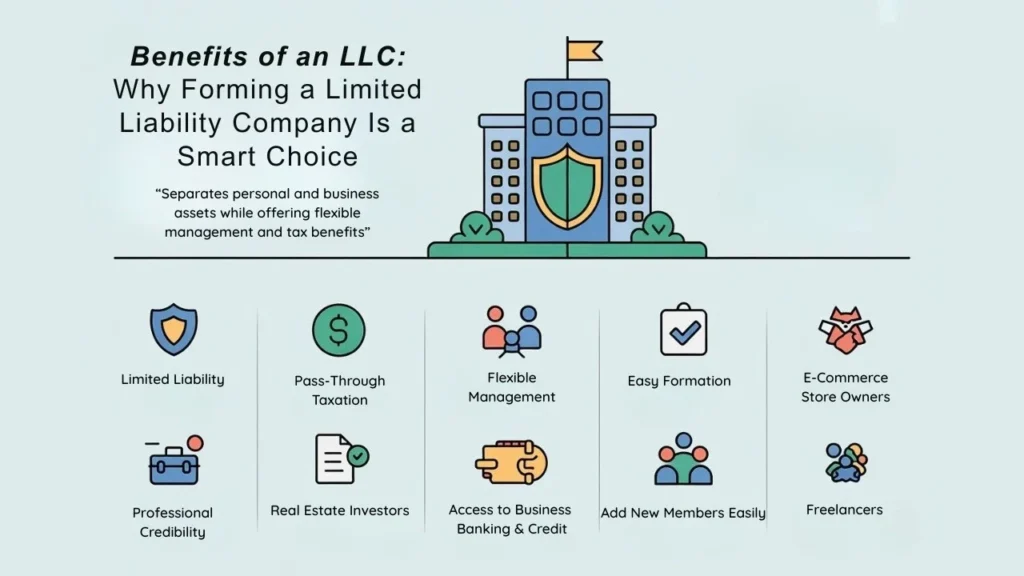
1. Limited Personal Liability Protection
One of the primary reasons entrepreneurs choose an LLC is asset protection. Members’ personal assets—homes, savings, and personal investments—are generally shielded from business debts and lawsuits. For instance, if an LLC faces a lawsuit or accrues debt, only the business’s assets are typically at risk, not the members’ personal property. This legal shield provides peace of mind and allows business owners to focus on growth rather than exposure to financial ruin.
2. Pass-Through Taxation Advantages
LLCs offer significant tax flexibility. By default, profits and losses pass through directly to members’ personal tax returns, avoiding corporate-level taxation. Unlike C-Corps, which are taxed at both the corporate and shareholder levels, LLCs allow members to benefit from deductions on business expenses, potentially lowering overall tax liability. Members can also elect S-Corp taxation to further optimize self-employment taxes when it makes financial sense.
3. Flexible Management Structure
LLCs can be member-managed—where all owners participate in running the business—or manager-managed, where designated managers handle day-to-day operations. This flexibility is especially appealing for small and mid-size businesses that may not require a formal board of directors but still want structured decision-making. Ownership percentages, profit distribution, and operational responsibilities can be tailored in the operating agreement to meet specific business needs.
4. Easy Formation and Low Maintenance Requirements
Compared to corporations, LLCs require minimal paperwork. Forming an LLC typically involves filing Articles of Organization with the state, paying filing fees, and maintaining basic annual compliance requirements, such as annual reports and fees. There’s no need for extensive board meetings, bylaws, or shareholder records, reducing administrative overhead and associated costs.
5. Professional Credibility for Your Business
Adding “LLC” to a business name signals legitimacy, instilling trust with customers, vendors, and potential investors. This simple designation can improve credibility, making it easier to secure contracts, attract partners, and establish professional relationships.
6. Ability to Add New Members Easily
LLCs can accommodate new owners or partners with relative ease. Unlike corporations, which require issuing shares and navigating shareholder agreements, LLCs can adjust ownership percentages and member roles through the operating agreement. This flexibility allows businesses to scale without administrative complications.
7. Access to Business Banking, Funding & Credit
Banks and lenders typically prefer dealing with LLCs over unregistered businesses or sole proprietorships. Forming an LLC enables owners to open dedicated business bank accounts, apply for loans under the company name, and begin establishing a business credit history. This separation between personal and business finances can also simplify accounting and tax reporting.
Additional Advantages Many Business Owners Don’t Know
Charging Order Protection
In many states, LLCs provide charging order protection, which safeguards the business from claims against an individual member’s personal assets. Creditors can access a member’s share of profits, but they cannot seize business assets directly, offering an extra layer of protection.
Separation of Personal & Business Finances
LLCs encourage clear financial separation, which not only strengthens liability protection but also simplifies bookkeeping and audit preparedness. This distinction is critical when applying for loans or dealing with IRS scrutiny.
Increased Privacy in Certain States
Certain states, such as Delaware and Wyoming, allow anonymous LLC formation. This protects members’ identities in public records and offers an additional layer of privacy and security.
Potential to Elect S-Corp Status for More Tax Savings
For LLCs generating significant profits, electing S-Corp status may reduce self-employment taxes. By paying owners a reasonable salary and distributing remaining profits as dividends, businesses can optimize tax liability legally and efficiently.
Real-World Examples: When Choosing an LLC Makes the Most Sense
- Freelancers & Independent Contractors: Protect personal assets while operating solo.
- Startups & Small Business Owners: Flexibility for growth and investment.
- Online Stores & E-Commerce Brands: Legal protection against liability from products or services.
- Real Estate Investors: Shield personal assets from property-related liabilities.
- Family-Owned or Partnership Businesses: Simplifies ownership transitions and profit sharing.
LLC Cost Breakdown: What to Expect in 2025
- State Filing Fees: $50–$500, depending on the state.
- Registered Agent Costs: $100–$300 annually.
- Annual Reports & Compliance Fees: $20–$200 yearly.
- Optional Services: Operating agreement drafting, EIN registration, and tax consultation ($100–$500).
LLC Requirements: What You Need to Form One
- Choosing a Business Name: Must be unique and meet state naming rules.
- Filing Articles of Organization: Submit with the state government and pay applicable fees.
- Creating an Operating Agreement: Documents roles, responsibilities, and ownership percentages.
- Getting an EIN: Required for taxes, banking, and hiring employees.
- Setting Up a Business Bank Account: Ensures financial separation and credibility.
Common Myths About LLCs (And the Truth Behind Them)
- Myth: LLCs Are Only for Small Businesses – LLCs can benefit businesses of all sizes, including large corporations seeking liability protection.
- Myth: LLCs Provide 100% Liability Protection – While robust, protection is not absolute; personal guarantees or illegal activities are not shielded.
- Myth: LLCs Are Too Expensive – Startup and ongoing costs are typically lower than corporations.
- Myth: Sole Proprietors Don’t Need an LLC – Even solo entrepreneurs benefit from liability protection, credibility, and tax flexibility.
LLC vs. Other Business Structures (Quick Comparison Table)
| Feature | LLC | Sole Proprietorship | C-Corp | S-Corp | Partnership |
| Liability Protection | Yes | No | Yes | Yes | Limited (varies) |
| Pass-Through Taxation | Default Yes | Yes | No | Yes | Yes |
| Formation Complexity | Low | Very Low | High | Medium | Medium |
| Management Flexibility | High | Owner Controlled | Board Controlled | Board Controlled | Shared |
| Credibility | High | Medium | High | High | Medium |
Frequently Asked Questions About LLC Benefits
Is an LLC good for beginners?
Yes, it offers protection and flexibility without complex corporate rules, making it ideal for first-time business owners.
Do LLCs pay less taxes?
LLCs can reduce taxes through pass-through taxation and S-Corp elections, though savings depend on income and business structure.
Does an LLC protect personal assets fully?
It protects most personal assets, but guarantees, fraud, or illegal acts are not shielded.
Is it worth forming an LLC for an online business?
Yes, it adds credibility, liability protection, and access to business banking and funding.
Can a single person form an LLC?
Absolutely. Single-member LLCs are common and offer the same benefits as multi-member LLCs.
Final Verdict: Should You Form an LLC?
Who Gets the Most Benefit?
Entrepreneurs, freelancers, e-commerce operators, and small business owners who want liability protection, tax flexibility, and credibility stand to gain the most from forming an LLC.
When Forming an LLC Is Not the Right Choice
Businesses with minimal liability risk, extremely tight budgets, or plans to go public immediately may consider alternative structures like sole proprietorships or corporations.
Final Expert Recommendation
For the majority of small-to-medium businesses, startups, and independent professionals, forming an LLC in 2025 offers a strategic balance of legal protection, operational flexibility, and financial efficiency. It remains a practical, cost-effective tool to protect personal assets while positioning a business for sustainable growth.