





In the modern global economy, where entire industries rely on interconnected supply chains and enterprise-level digital infrastructure, the Business-to-Business (B2B) model is more important than ever. From the technology that powers corporate data centers to the raw materials that fuel manufacturing plants, B2B transactions form the foundation of global commerce. Yet despite its scale and influence, the true meaning of B2B is often misunderstood. Many people associate it only with large corporations, when in reality, millions of small and mid-sized businesses participate in the B2B ecosystem every day.
Understanding what B2B is and how it works is essential for entrepreneurs, professionals, and consumers alike, because B2B drives innovation, pricing, logistics, and ultimately, the availability of the products and services we use daily.
Have questions about this story?Ask Tundra for more details, context, or updates.
What Does B2B Mean?
B2B, or Business-to-Business, is a commercial model where one business provides products, services, or solutions to another business. It includes wholesale trade, SaaS, enterprise software, logistics, supply chain operations, and professional services.
The Basic Definition of B2B
The B2B Definition, or Business-to-Business, refers to any transaction, product, or service exchanged between two businesses rather than between a business and individual consumers. This can range from enterprise software to industrial equipment, or from marketing services to wholesale supplies. The common thread is that the end user is another business, and the value delivered must support operations, efficiency, or profitability on an organizational level.
What Makes B2B Different From Other Business Models
What fundamentally separates B2B from B2C (Business-to-Consumer) or B2G (Business-to-Government) is the nature of the decision-making process. In B2B, the purchase rarely rests on personal preference. Instead, it involves organizational priorities such as return on investment, compliance, operational efficiency, or long-term scalability. B2B products or services must justify their value through measurable impact.
Furthermore, B2B sales cycles are longer, more analytical, and more collaborative. A single purchase might involve input from executives, procurement teams, technical specialists, finance departments, and end users. Because of this complexity, B2B relationships often develop over months or even years, relying on credibility, industry expertise, and proven performance.
Evolution of B2B in the Digital Era
B2B has undergone one of the most significant transformations of any sector in the last decade. Historically, business-to-business commerce relied heavily on in-person meetings, trade shows, catalogs, and manual negotiations. But the rise of ecommerce, artificial intelligence, cloud computing, and enterprise digital tools fundamentally changed how businesses buy and sell.
Today, many B2B buyers prefer self-service ordering portals, digital procurement platforms, automated renewal systems, and virtual demos. AI tools help businesses evaluate vendors faster, forecast needs more accurately, and track ROI more precisely. As a result, B2B purchasing has become faster, more efficient, and more transparent—moving away from paper-heavy negotiations to data-driven digital ecosystems.
How the B2B Model Works In Real-World Supply Chains
The Role of Suppliers, Manufacturers & Distributors
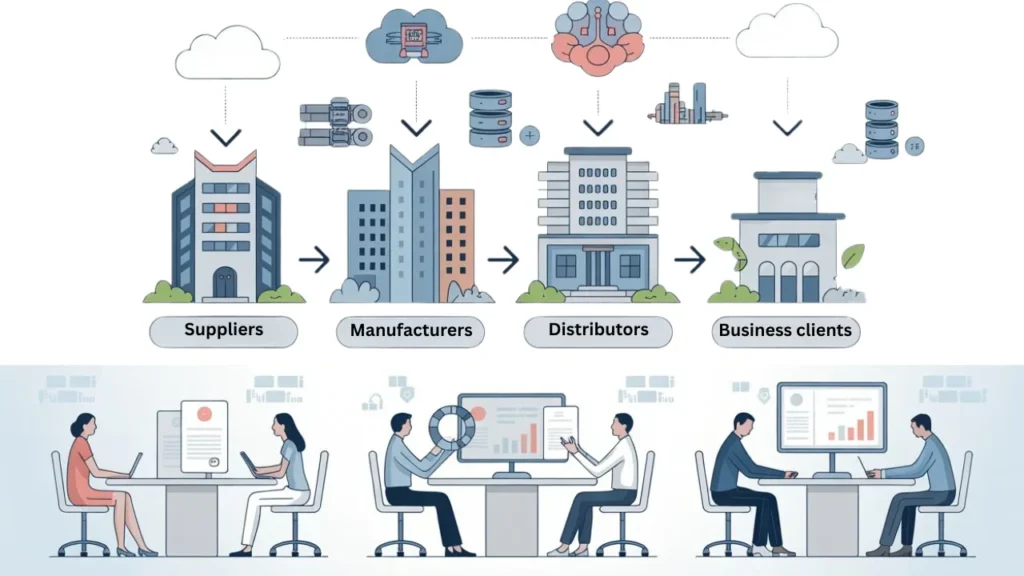
A typical B2B ecosystem involves several interconnected players, each contributing a specific part of the value chain. Suppliers produce raw materials; manufacturers convert them into finished or semi-finished goods; and distributors bridge the gap by storing, transporting, and delivering these goods to retailers, wholesalers, or enterprise clients. This multi-layer structure allows industries to scale and ensures that products reach the right buyers in the right quantities. Without B2B partnerships at every stage from sourcing minerals to assembling devices industries like construction, technology, healthcare, and transportation would collapse overnight.
Business Buyers vs. Consumer Buyers
Business buyers operate with entirely different motivations compared to consumers. A consumer might buy something because it’s appealing, affordable, or trendy. A business buyer must justify purchasing decisions through efficiency gains, operational improvements, or quantifiable financial returns. Their decisions are governed by budgets, compliance requirements, internal approvals, and long-term strategic goals. This makes B2B selling less about persuasion and more about demonstrating expertise, reliability, and measurable value.
Long-Term Contracts & High-Value Transactions
Since B2B purchases often involve large investments, businesses prefer structured agreements that guarantee stability. These agreements can include multi-year service contracts, licensing arrangements, equipment leases, or recurring supply deals. Such contracts allow companies to project future expenses, secure consistent quality, and reduce the risk of supply chain disruptions. For vendors, these long-term relationships provide predictable revenue streams and opportunities for upselling or expanding services as the client grows.
Decision-Making Processes in B2B
The B2B decision-making process is methodical and often data-heavy. It typically begins with identifying a problem or opportunity, followed by extensive research, comparison of vendors, consultations with internal teams, and negotiations regarding price, service levels, warranties, and legal terms. This structured process ensures that the purchase benefits the organization as a whole rather than satisfying a single individual’s preference. As a result, the most successful B2B companies are those that simplify decision-making by providing transparency, strong support, and clear evidence of performance.
Types of B2B Businesses
1. B2B Product Companies
These businesses manufacture or supply physical goods that other companies need to operate. Industrial manufacturers produce machinery and components, wholesale suppliers distribute large quantities of materials, and tech hardware providers supply devices like routers, servers, and point-of-sale systems. Their products typically support essential functions within other businesses, from production lines to front-office operations.
2. B2B Service Companies
Service-based B2B companies deliver professional expertise that helps other organizations function more effectively. This includes SaaS providers offering cloud-based tools, marketing agencies helping companies manage branding and campaigns, accounting firms ensuring compliance, and IT or cybersecurity providers protecting digital assets. These services are valued for their ability to reduce operational burdens, increase efficiency, or mitigate risk.
3. B2B Ecommerce
B2B ecommerce represents one of the fastest-growing segments of global trade. Companies purchase wholesale goods, supplies, or equipment through online platforms offering streamlined ordering, contract pricing, real-time inventory visibility, and automated reordering. This digital shift is reshaping how small and large businesses manage procurement.
4. B2B Distributors & Logistics
Logistics providers such as freight carriers, warehousing firms, and distribution centers enable the movement of goods across cities, countries, and continents. Their role is crucial in ensuring the timely flow of products through supply chains. Without B2B logistics companies, manufacturing, retail, and ecommerce sectors would be unable to function.
B2B vs. B2C vs. B2G: Key Differences
B2B relationships are built differently from consumer or government-facing models. B2C focuses on individual buyers with short purchase cycles, emotional decision-making, and standardized pricing. B2G, on the other hand, requires navigating government regulations, compliance standards, bidding processes, and long lead times.
B2B falls between these models but leans closer to B2G in terms of complexity. Pricing in B2B is rarely fixed; it involves negotiations, volume discounts, or long-term agreements. Relationships in B2B also carry more weight because switching vendors can disrupt operations or lead to financial losses. This is why enterprise clients often remain loyal to vendors who provide reliability, transparency, and consistent value.
Benefits of the B2B Model
B2B companies benefit from significantly higher order values compared to consumer-focused businesses. A single enterprise client may place orders equivalent to thousands of individual retail purchases, creating a more stable revenue stream.
Moreover, B2B transactions naturally support recurring business, whether through contracts, subscriptions, reorders, or equipment maintenance. This repeatability stabilizes cash flow and allows businesses to grow sustainably. B2B customers are also generally less sensitive to price fluctuations because they evaluate decisions based on long-term efficiency and ROI rather than immediate affordability.
Scalability becomes easier as well. Once a B2B company acquires a strong client base or integrates into a supply chain, expansion often involves entering new markets, adding product lines, or leveraging digital platforms to improve reach and efficiency. In a competitive economy, these advantages make B2B one of the most profitable business models.
Real-World Examples of B2B Companies
Several global leaders exemplify the power and diversity of B2B. Amazon Business has transformed online procurement by offering corporate pricing, bulk ordering, and streamlined purchasing tools for organizations. Salesforce revolutionized customer relationship management through cloud-based software that supports sales and marketing teams in thousands of companies worldwide. HubSpot built an ecosystem for inbound marketing, empowering businesses to attract, engage, and retain customers more effectively.
Alibaba has connected millions of suppliers and wholesale buyers globally, becoming a cornerstone of international trade. Meanwhile, logistics giants like FedEx and UPS ensure the movement of products across borders, powering supply chains from medical shipments to e-commerce fulfillment. These companies showcase the breadth of innovation and influence within the B2B sector.
How B2B Sales Work
B2B sales typically begin with lead generation, where companies identify potential buyers using digital marketing, SEO, networking, referrals, or trade events. After initial contact, sellers may adopt account-based marketing strategies, tailoring their messaging to specific high-value prospects.
Once interest is established, the sales process expands into multiple touchpoints: discovery calls, product demonstrations, technical evaluations, proposal submissions, and negotiation of terms. Unlike B2C, B2B sales must address organizational goals, regulatory requirements, integration needs, and long-term support expectations. This depth and structure reflect the high stakes of enterprise-level purchasing.
Modern B2B Marketing Strategies (2026 Best Practices)
The digital era has reshaped B2B marketing. Companies rely heavily on content marketing and SEO to educate buyers through reports, articles, case studies, and whitepapers. LinkedIn has become a dominant channel for reaching executives and decision-makers. Email automation allows companies to deliver targeted information as buyers move through the research phase.
Webinars, workshops, and industry events serve as educational touchpoints, providing credibility and establishing expertise. Even in-person trade shows remain relevant, offering opportunities for relationship building and direct engagement with enterprise clients.
B2B Trends to Know in 2025
Several trends are defining B2B in 2025. Artificial intelligence and automation are transforming everything from lead scoring to customer support. The rapid rise of B2B ecommerce continues, with more companies preferring digital procurement platforms over traditional ordering methods. Data-driven decision-making is now standard, giving businesses deeper insights into performance and forecasting.
Video-based selling has also gained momentum, offering more efficient and personalized interactions in a remote-first world. Additionally, sustainability and responsible sourcing are becoming non-negotiable as companies evaluate their partners based on environmental and ethical standards.
Common Misconceptions About B2B
One widespread misconception is that B2B is dominated by large corporations. In reality, small and mid-sized businesses represent the majority of B2B suppliers and service providers. Another misconception is that B2B does not require marketing. In fact, B2B buyers conduct extensive research before contacting sales teams, making marketing essential for visibility and trust.
Some assume that B2B sales are always slow or bureaucratic, but digital tools have streamlined procurement, communication, and contract management. Others believe that only corporations buy B2B products, overlooking the significant role of small businesses, nonprofits, and educational institutions in the B2B ecosystem.
FAQs About B2B Meaning
1. What does B2B slang mean?
B2B slang refers to “business-to-business,” describing interactions, deals, or services that happen between companies rather than with individual consumers. On social media and casual conversation, it often highlights professional partnerships, industry-level services, or business networking.
2. What is B2B and examples?
B2B, or business-to-business, is a model where one company sells products or services to another company. Examples include software providers selling tools to corporations, wholesalers supplying retailers, manufacturers providing components to other industries, and marketing agencies offering services to businesses.
3. What is B2B or B2C?
B2B (business-to-business) involves selling products or services to other companies, while B2C (business-to-consumer) sells directly to individual customers. B2B usually involves larger contracts, relationship-based sales, and logical marketing, whereas B2C focuses on quick purchases, emotional appeal, and consumer convenience.
4. What does B2B mean in Urban Dictionary?
On Urban Dictionary, B2B is defined as “business-to-business” and is often used to describe professional deals, corporate networking, or industry interactions. Although entries can be casual or humorous, the main meaning still aligns with traditional business-to-business operations.
5. What does B2B mean in social media?
In social media, B2B refers to content or marketing aimed at other businesses. It often includes industry insights, professional updates, and services promotion on platforms like LinkedIn. The goal is usually to generate leads, build credibility, and connect with decision-makers.
Final Thoughts: Why B2B Matters in Today’s Economy
B2B is the foundation of economic stability and growth. It underpins every product we buy, every service we use, and every industry that powers modern life. As digital transformation accelerates, the B2B landscape continues to evolve, becoming faster, smarter, and more global.
For businesses, understanding B2B is not merely academic—it is essential for navigating today’s interconnected economy. Whether companies are sourcing raw materials, investing in enterprise software, or forming strategic partnerships, the B2B ecosystem provides the infrastructure that keeps the world operating efficiently and competitively.