



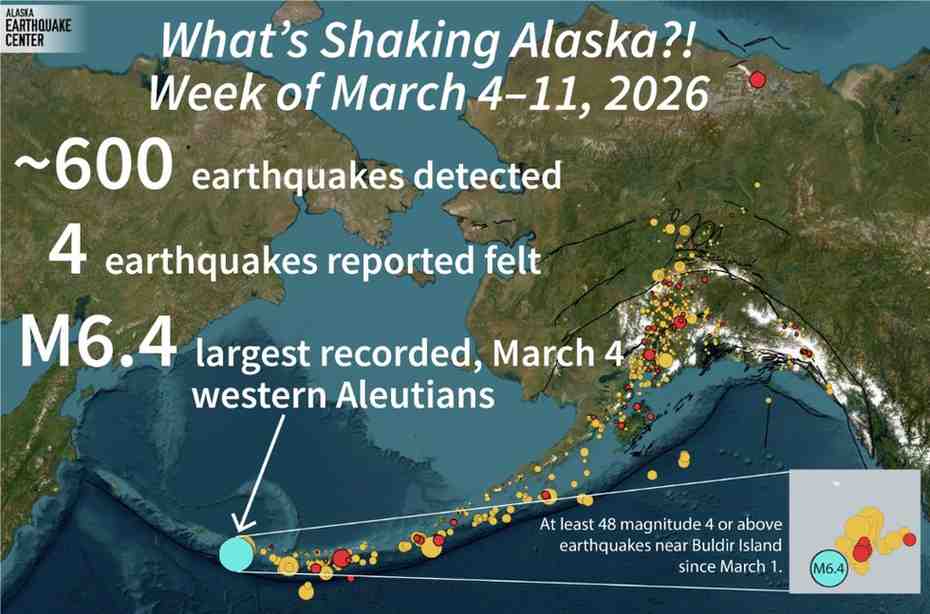
ANCHORAGE, Alaska — The Alaska Earthquake Center reported around 600 earthquakes across the state over the past week, with increased activity in the western Aleutians.
According to the center, the region experienced a magnitude 6.4 earthquake on March 4, along with several other earthquakes in the 4-5 magnitude range. Despite the elevated activity, no major impacts were reported.
This week also marks the 15th anniversary of the 2011 magnitude 9.1 Tōhoku earthquake in Japan, one of the most powerful earthquakes ever recorded. The earthquake struck off the northeastern coast of Honshu and triggered a devastating tsunami that led to the loss of more than 20,000 lives, most of them due to the waves rather than the ground shaking.
A seismic analyst with the Alaska Earthquake Center, who was in Japan at the time, recalled experiencing the event from a distance. Although the shaking initially seemed mild, widespread tsunami footage soon revealed the scale of the disaster. When returning home weeks later, the earthquake’s effects were still visible, with household items displaced and damage evident indoors.
The 2011 event also had measurable effects in Alaska. Tsunami waves reached parts of the Aleutian Islands within hours, producing wave heights of less than three feet but still creating dangerous currents and hazardous conditions in coastal areas.
Scientists say the Tōhoku earthquake changed how tsunami risks are evaluated. The event showed that very large movements can occur in shallow parts of subduction zones, producing larger-than-expected tsunamis. As a result, hazard assessments in Alaska have been updated to reflect more extreme “worst-case” scenarios.
Officials say sharing this information helps coastal communities improve emergency planning and strengthen long-term resilience.
Residents can find more information about tsunami risks and preparedness through the Alaska Earthquake Center’s website.