




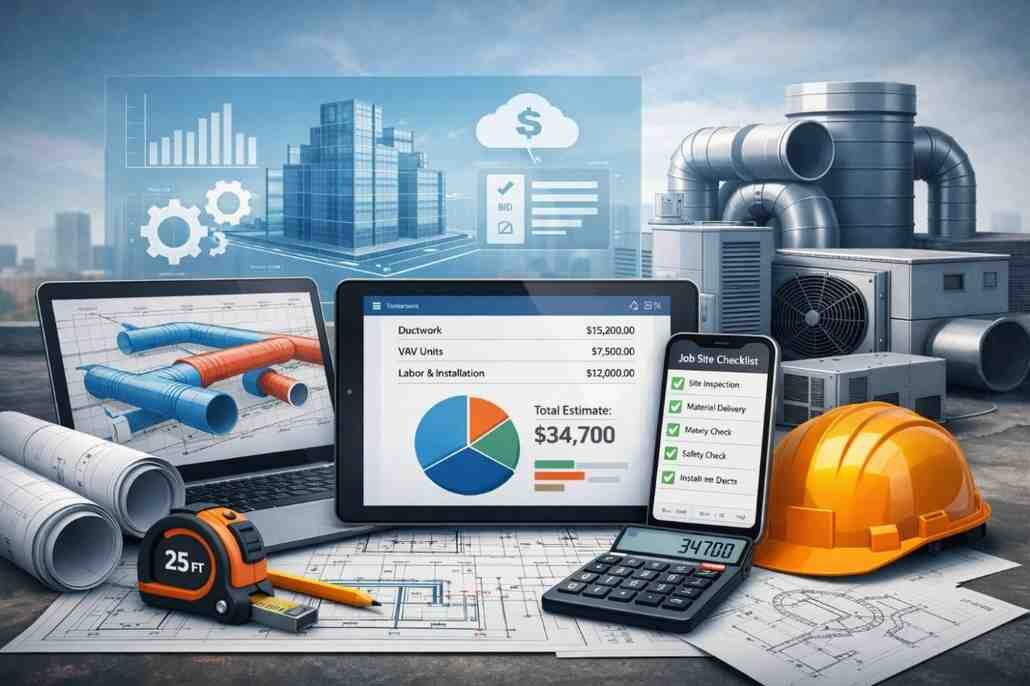
For decades, the construction and mechanical contracting industry has relied heavily on manual processes for estimating costs and preparing bids. HVAC estimating, in particular, has always been one of the most demanding areas. The reason is simple. Duct systems, piping layouts, fittings, air terminals, and equipment coordination all need careful attention, and even small mistakes can affect the entire estimate. As construction projects grow in size and deadlines tighten, traditional estimating methods are struggling to keep pace with real-world demands. In fact, 44 % of U.S. construction contractors expect to increase investment in AI, making it the most popular tech investment among contractors in 2025.
To address this pressure, software technology, especially artificial intelligence, is becoming a core part of modern HVAC estimating workflows. AI-enabled HVAC estimating software allows estimators to automate repetitive tasks, improve accuracy, and handle more bids without losing control or professional judgment. These tools are not designed to replace experienced estimators. Instead, they work as intelligent assistants that improve productivity and support more thoughtful decision-making.
Limitations of Traditional HVAC Estimating Methods
Manual HVAC takeoff requires estimators to review mechanical drawings line by line, measure duct runs, count fittings, and cross-check schedules in detail. While this approach has worked for years, it is incredibly time-consuming and depends heavily on individual focus and experience.
Some of the most common challenges include
- Extended turnaround times: Large or complex projects often take several days to quantify accurately.
- Higher risk of errors: Missed components or incorrect measurements can directly affect bid accuracy and profitability.
- Difficulty scaling operations: Estimating teams are limited by available time and manpower, especially during peak bidding periods.
- Inefficiency during revisions: Addenda and drawing updates frequently require estimators to redo significant portions of the takeoff. Because of these issues, contractors may struggle to respond quickly to bid invitations or pursue multiple projects at the same time.
The Growing Role of AI in Estimating Software
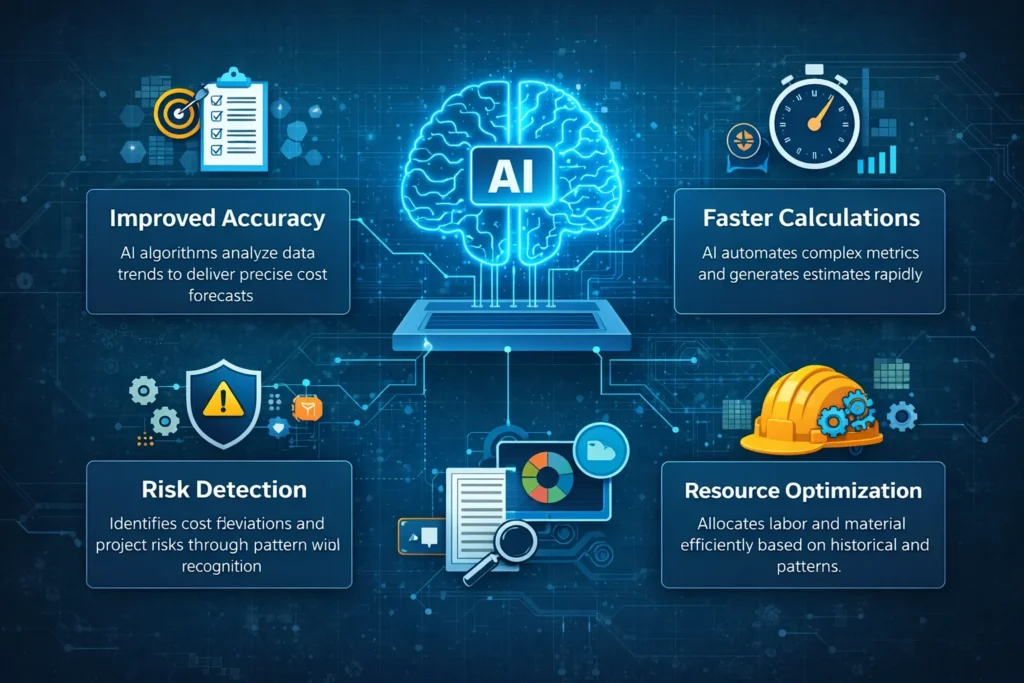
Artificial intelligence brings automation and pattern recognition into the estimating process. AI-powered HVAC estimating software can analyze digital drawings, recognize mechanical symbols, and extract quantities such as duct lengths, pipe diameters, fittings, and equipment counts with greater consistency.
From a software engineering perspective, these systems rely on machine learning models trained on extensive collections of construction drawings. Over time, AI tools improve reliability by learning from historical project data and quality reviews. This results in more standardized outputs regardless of drawing style complexity or project scale.
Automating HVAC Takeoffs with AI Assistance
Most AI-supported HVAC estimating solutions follow a structured workflow that fits naturally into existing estimating practices.
- Digital plan ingestion: Mechanical drawings are uploaded as PDFs and categorized automatically.
- Scope configuration: Estimators define the project scope, system boundaries, and exclusions.
- Automated quantity extraction: The AI processes drawings and identifies relevant HVAC components.
- Validation and review: Outputs are reviewed before being used for pricing and bid preparation.
This approach significantly reduces repetitive manual tracing while maintaining estimator oversight and accountability.
Efficiency, Accuracy, and Workflow Optimization
One of the most noticeable advantages of AI-enhanced HVAC estimating software is improved efficiency. By automating quantity extraction, estimators spend far less time on takeoffs and more time on cost analysis, supplier coordination, and risk assessment.
Additional benefits include
- Greater consistency: Standardized extraction methods reduce differences between individual estimators
- Lower rework rates: Fewer missed items lead to more reliable bids and fewer corrections later.
- Improved collaboration: Structured outputs make it easier to share data across teams and departments.
For companies managing a high volume of bids, these improvements often translate into a clear competitive edge.
Also Read: Top 10 Best HVAC Companies in the USA 2025 | Reviews & Brands
Supporting Complex and Integrated Construction Systems
Modern construction projects increasingly involve tightly integrated mechanical, electrical, and plumbing systems. Advanced HVAC estimating software is evolving to support multisystem analysis, helping estimators understand how interconnected components affect overall project costs. Forbes highlights that artificial intelligence (AI) is becoming increasingly pivotal in cost engineering and construction workflows, improving predictive analytics and helping forecast cost overruns and risks earlier in project planning.
This capability is especially valuable for large commercial and industrial projects where coordination challenges can quickly impact schedules and budgets. By improving visibility into system interactions early in the bidding process, AI-driven tools support more informed decisions.
HVAC Estimating Software as a Strategic Technology Asset
From a broader software technology standpoint, AI-enabled estimating tools represent a shift toward data-driven construction planning. These platforms are designed to integrate with existing estimating systems by exporting data in familiar formats such as spreadsheets and reports.
This allows organizations to adopt AI, gradually improving workflows without disrupting established processes. Over time, AI-supported estimating becomes a strategic asset, strengthening predictability, scalability, and operational efficiency.
The Future of AI in Construction Estimation
As artificial intelligence continues to advance in construction, software is expected to expand beyond takeoffs to include cost forecasting, risk modeling, and project optimization. For HVAC estimating, this evolution points toward more intelligent, adaptive workflows that balance automation with professional expertise.
Contractors who adopt these technologies early are better prepared to handle market pressure, manage complexity, and maintain accuracy in an increasingly competitive environment.
Also Read: Enhancing Project Efficiency Through Streamlined Construction Coordination
Conclusion
AI-powered HVAC estimating software is changing how mechanical contractors approach takeoffs and bid preparation. By reducing manual workloads, improving consistency, and supporting complex project requirements, these tools help estimators work more efficiently without sacrificing judgment or quality. Many mechanical firms, such as Axion Specialty Contracting, have shown that technology-driven estimating workflows improve internal efficiency and enable teams to handle higher bid volumes with confidence.
The move toward AI-assisted estimating is not about replacing human expertise. It is about enhancing it. As software technology continues to evolve, HVAC professionals who use intelligent estimating solutions will be better positioned to adapt to scale and succeed in the digital future of construction.