




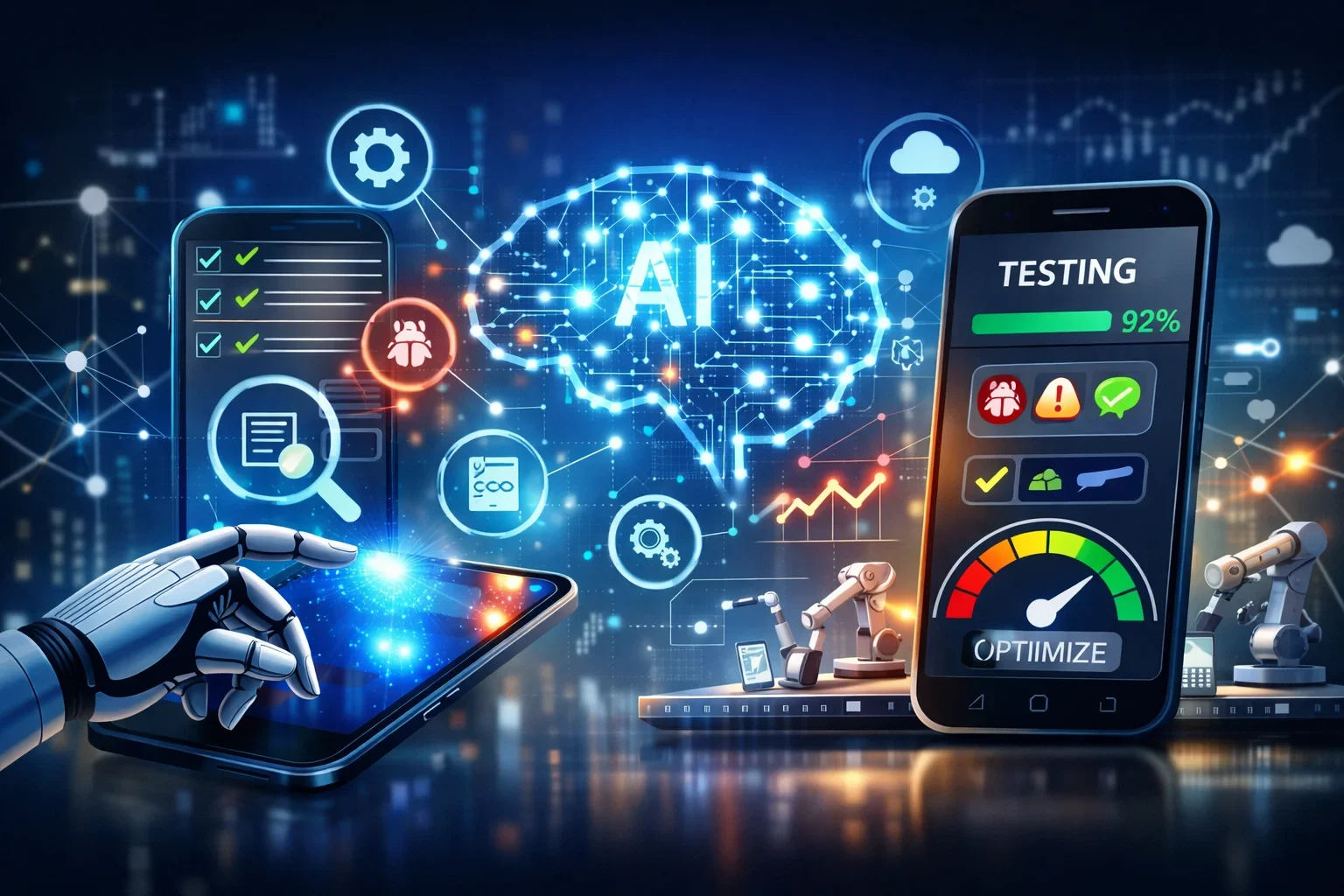
Mobile applications are now central to our daily lives, from banking and education to entertainment and health. With millions of apps competing for attention, quality assurance (QA) has never been more critical. Users expect flawless experiences, instant responsiveness, and consistent performance across varied devices and network conditions. Traditional approaches to mobile app QA, manual testing, or basic automation are struggling to keep up with the speed and scale that modern development demands.
That’s where Artificial Intelligence (AI) steps in, transforming QA from a repetitive checkpoint into an intelligent, adaptive, and proactive practice. Forbes Advisor notes that AI technologies are being rapidly adopted across core business functions, with many organizations already relying on AI in daily operations. This widespread adoption lays a clear foundation for extending AI into quality assurance, where it can automate testing, detect defects earlier, and adapt to the complexity of modern mobile app development.
In this article, we explore how AI is revolutionizing mobile app quality assurance, making it faster, smarter, and more efficient than ever before.
Have questions about this story?
Ask Tundra for more details, context, or updates.
The Limitations of Traditional QA
Manual HVAC takeoff requires estimators to review mechanical drawings line by line, measure duct runs, count fittings, and cross-check schedules in detail. While this approach has worked for years, it is incredibly time-consuming and depends heavily on individual focus and experience.
- Device Fragmentation: Thousands of device models, screen sizes, OS versions, and hardware configurations demand extensive testing.
- Rapid Release Cycles: Agile and DevOps practices push for frequent builds and releases, often weekly or even daily.
- Dynamic Interfaces: UI changes, feature updates, and platform variations make traditional scripted testing brittle and costly to maintain.
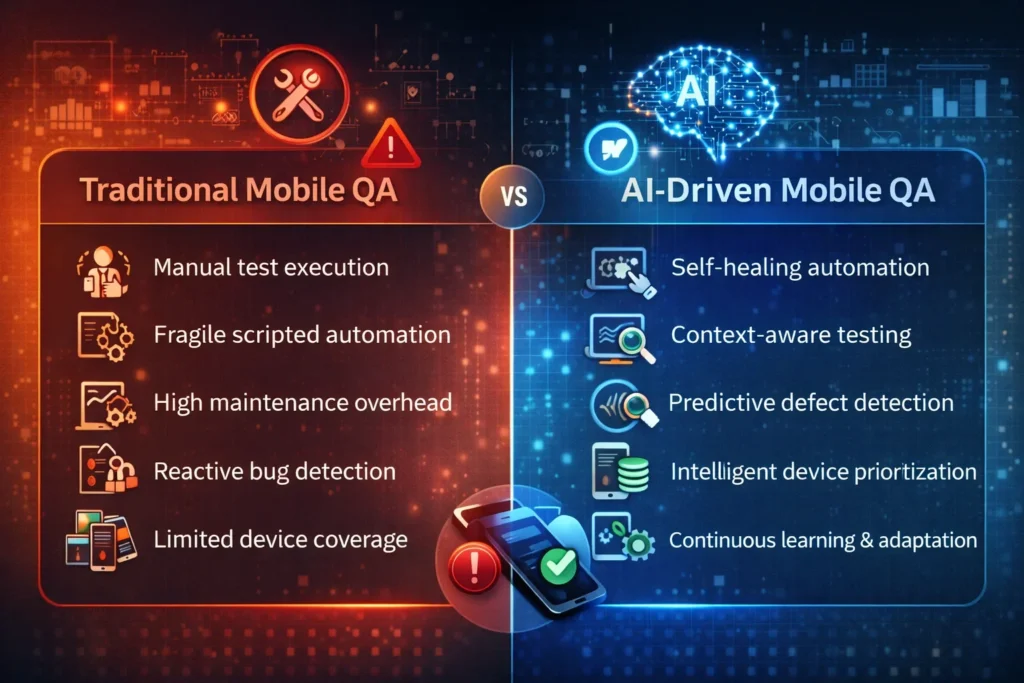
- Manual Overhead: Manual testing cannot scale to cover all scenarios, and script-based automation breaks easily with UI or code changes.
These limitations create bottlenecks that slow down development, increase costs, and risk poor user experiences if defects slip through.
Also Read: The Ultimate Guide to Choosing the Best Mobile Devices for Testing in 2026
Enter AI: A New Era for QA
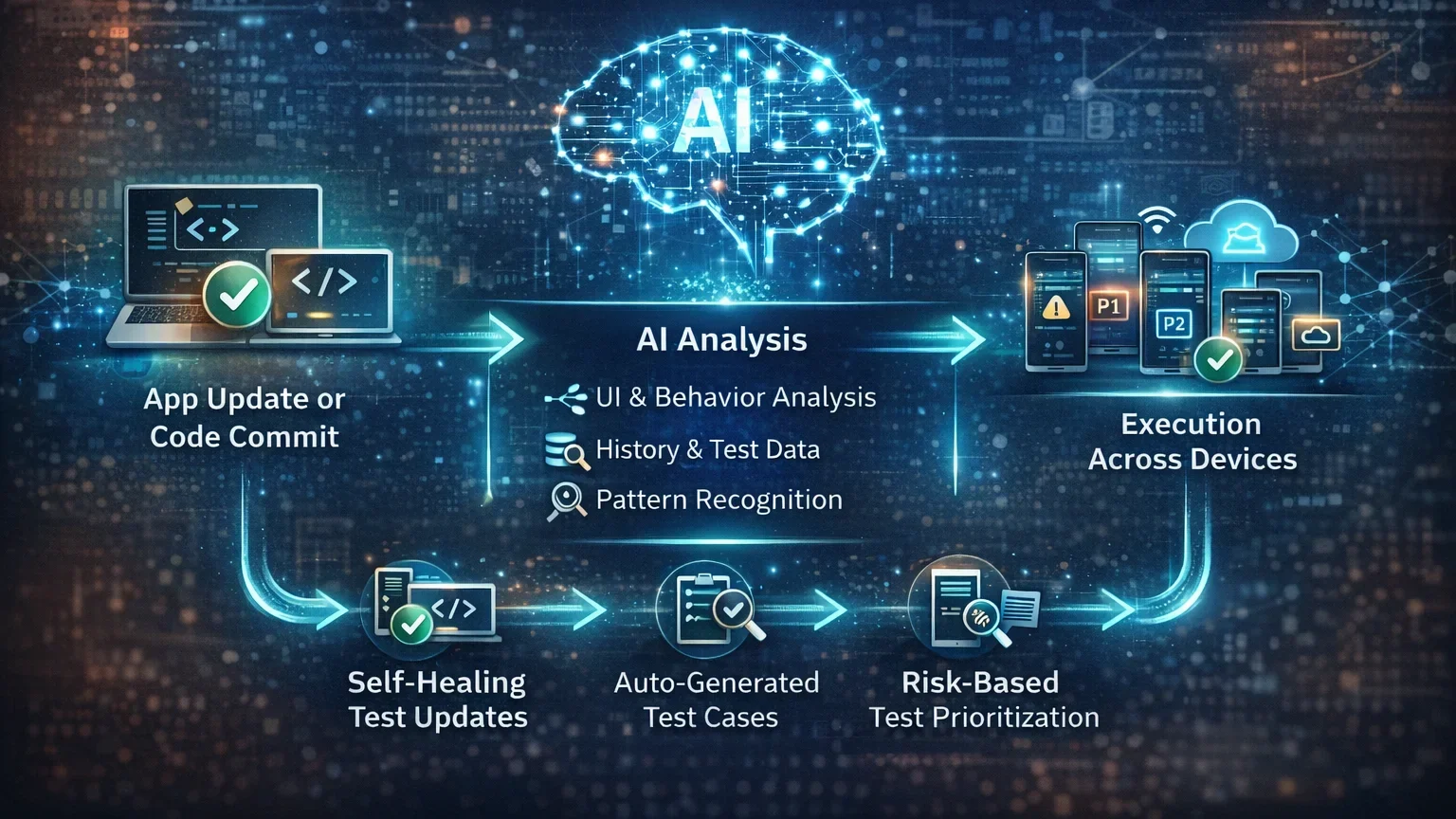
AI is fundamentally reshaping mobile QA by introducing machine learning (ML), computer vision, natural language processing (NLP), and predictive analytics into the testing workflow. Rather than merely executing predefined scripts, AI systems learn from app behavior, identify patterns, and make intelligent decisions,a game-changer for quality engineering.
Also Read: 6 AI Testing Tools to Boost Your QA Team’s Efficiency
Here’s how AI is revolutionizing mobile QA:
1. Self-Healing Test Automation
Traditional automation test scripts often break with every UI change,a new button name, a redesigned screen layout, or a modified element locator can render hundreds of tests obsolete. AI solves this with self-healing automation, where test frameworks automatically adapt to UI changes without manual intervention.
AI-driven tools analyze visual and structural elements, understand context, and update locators or test flows on the fly. This dramatically reduces maintenance overhead and ensures tests remain relevant even as apps evolve.
2. Predictive Analytics and Proactive Defect Detection
One of AI’s most transformative impacts on QA is the shift from reactive to proactive defect management. Machine learning models analyze historical test results, recent code changes, and usage data to predict where bugs are most likely to occur. This allows QA teams to prioritize tests by risk level, reducing time spent on redundant runs and increasing the likelihood of catching critical issues early.
Predictive analytics doesn’t just speed up testing; it focuses testing where it matters most, increasing efficiency and reducing time-to-market.
3. Intelligent Test Creation and Optimization
AI can automatically generate test cases from user stories, requirements, or even natural language descriptions. Modern AI frameworks take plain-English scenarios and convert them into executable test scripts. This capability democratizes test creation and greatly accelerates coverage.
For example, instead of writing hundreds of lines of code to automate login, shopping cart flows, or navigation paths, testers can describe scenarios in simple language, and AI handles the rest. AI also optimizes test suites, identifying redundant or low-value cases and suggesting the most effective ones based on historical outcomes.
4. Enhanced Visual and Accessibility Testing
Visual consistency across devices is a significant challenge in mobile QA. Subtle visual bugs, misaligned buttons, broken layouts, and font issues can slip past manual checks. AI-powered visual testing tools use computer vision to compare UI snapshots at scale, detecting pixel-level differences across screens and devices. These tools are especially helpful when troubleshooting device issues like a Phone Say “SOS Only” message, ensuring apps function correctly even under network or connectivity constraints.
Similarly, AI can assess accessibility compliance (e.g., contrast ratios or screen reader compatibility) automatically,a task that would be extremely time-consuming without automation.
5. Continuous Integration/Continuous Delivery (CI/CD) Acceleration
AI fits seamlessly into modern DevOps pipelines. Triggered by code commits or pull requests, AI-enhanced test suites provide rapid feedback loops, detecting issues almost in real time and enabling developers to fix bugs before deployment.
This integration of AI with CI/CD pipelines helps teams maintain high velocity without sacrificing quality, empowering continuous delivery practices that meet both speed and reliability goals.
6. Handling Device Fragmentation at Scale
Testing across hundreds or thousands of real devices has been historically expensive and complex. AI doesn’t remove the need for broad device coverage, but makes it more manageable and intelligent. By analyzing usage data and defect patterns, AI can prioritize high-impact devices and configurations, ensuring that testing resources focus on the combinations that matter most to users.
Benefits for Mobile QA Teams
The adoption of AI in mobile QA delivers both tactical and strategic benefits:
- Speed and Efficiency: Automated execution and intelligent prioritization dramatically reduce testing cycles.
- More intelligent Resource Allocation: Teams spend less time maintaining scripts and more time on exploratory and creative testing.
- Improved Accuracy: AI detects subtle anomalies that humans might miss, significantly enhancing defect-detection rates.
- Actionable Insights: Rather than just reporting failures, AI can help diagnose root causes, enabling quicker fixes.
- Cost Savings: Early detection of defects and reduced maintenance overhead significantly reduce total QA costs.
Challenges and Human Collaboration
While AI is mighty, it doesn’t fully replace human expertise. AI can generate false positives, misinterpret edge cases, or require oversight for critical decisions. Human testers remain essential for exploratory testing, UX judgment, contextual insight, and final validation, especially when nuanced reasoning is needed.
The most effective QA teams will blend AI’s automation capabilities with human creativity and critical thinking.
Looking Ahead: The Future of AI in Mobile QA
The evolution of AI in mobile QA is still in early phases, but the trajectory is unmistakable:
- Agentic AI Test Agents: These will autonomously manage end-to-end QA flows, from planning and script generation to execution and analysis.
- Generative AI for Test Data: AI will generate realistic test data that mimics real-world scenarios while preserving privacy and compliance.
- Deep Learning for Behavioral Testing: Models will simulate and predict user behavior, uncovering issues traditional tests might miss.
In the coming years, AI will not just augment QA, it will redefine it.
Conclusion
In the fast-paced world of mobile app development, AI isn’t just a luxury; it’s a necessity. By automating repetitive tasks, enhancing accuracy, and providing intelligent analytics, AI is propelling mobile app and web app testing into a new era of intelligence and efficiency. Traditional barriers such as device fragmentation, frequent UI changes, and cross-platform inconsistencies are no longer insurmountable obstacles but opportunities for smarter, AI-driven testing.
For digital product teams that embrace AI, the result is higher-quality applications delivered faster, improved end-user experiences across mobile and web platforms, and a clear strategic advantage in an increasingly competitive landscape.